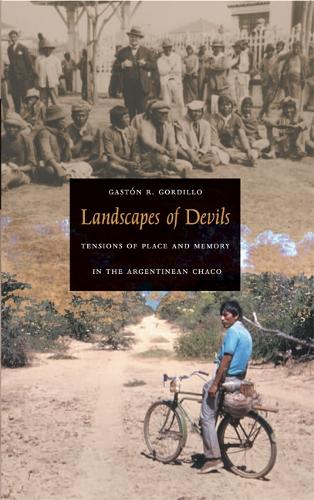
Книга Landscapes of Devils: Tensions of Place and Memory in the Argentinean Chaco
Examines the inscription of historical forces in the senses of place of the Tobas, an indigenous people of the Argentinean Chaco region whose recent history has been torn between exploitation in sugar plantations and relative autonomy in the bush.
Landscapes of Devils is a rich, historically grounded ethnography of the western Toba, an indigenous people in northern Argentina’s Gran Chaco region. In the early twentieth century, the Toba were defeated by the Argentinean army, incorporated into the seasonal labor force of distant sugar plantations, and proselytized by British Anglicans. Gastón R. Gordillo reveals how the Toba’s memory of these processes is embedded in their experience of “the bush” that dominates the Chaco landscape.
As Gordillo explains, the bush is the result of social, cultural, and political processes that intertwine this place with other geographies. Labor exploitation, state violence, encroachment by settlers, and the demands of Anglican missionaries all transformed this land. The Toba’s lives have been torn between alienating work in sugar plantations and relative freedom in the bush, between moments of domination and autonomy, abundance and poverty, terror and healing. Part of this contradictory experience is culturally expressed in devils, evil spirits that acquire different features in different places. The devils are sources of death and disease in the plantations, but in the bush they are entities that connect with humans as providers of bush food and healing power. Enacted through memory, the experiences of the Toba have produced a tense and shifting geography. Combining extensive fieldwork conducted over a decade, historical research, and critical theory, Gordillo offers a nuanced analysis of the Toba’s social memory and a powerful argument that geographic places are not only objective entities but also the subjective outcome of historical forces.
"“Gordillo’s analysis is nuanced and engagingly written. The strength of this book lies in its deep, ethnographically grounded, and historically situated research, as well as in its emphasis on the ambiguities, tensions, and social contradictions that construct memory and place.”" - American Anthropologist
"“The author’s methodology—based on extensive data collection, almost twenty years of sincere relationship with the people in the field, solid archival research, and rigorous use of negative dialectic—has produced a unique ethnography of the tensions of places and memories that could inspire similar type of work among other indigenous peoples.”" - Journal of the Royal Anthropological Institute
"“This book is at once a superb ethnography and a challenging theoretical reflection on the agency of indigenous people faced with profound economic and political change.”" - Latin American Studies
"[I]mpressive. . . . [T]he author's approach (data collection sustained by a long-term sincere relationship with the people in the field, solid archival research, and rigorous use of negative dialectic) have produced a unique ethnography of tensions of places and memories." - American Ethnologist
"History, geography, sociology and anthropology come together in this gripping, if depressing, account of the destruction of a people's independence and of their environment. The book throws light on events in a part of the world not so well known as they might be and that should be of wider interest." - International Journal of Environmental Studies
"This is a welcome, fresh perspective that emerges from traditional ethnographic research methods. Highly recommended. All levels/libraries." - Choice