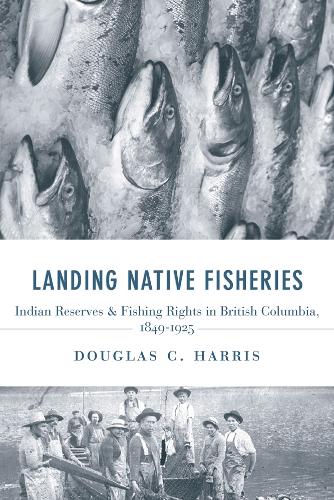
In this brilliant and eloquent study of law and colonialism, University of British Columbia professor Douglas C. Harris shows us that, in British Columbia, the sea and the fisheries were central to European conquest as the colonial state asserted its sovereignty by eliminating the customary rights of Native fishers and consolidating its legal hold over maritime resources. Harris, the author of Fish, Law, and Colonialism, deftly shows us how law, more than military power, was used to transfer control of British Columbia's fishery resources from Native communities to state authorities. -- David Arnold The Northern Mariner, October 2009
Landing Native Fisheries reveals the contradictions and consequences of an Indian land policy premised on access to fish, on one hand, and a program of fisheries management intended to open the resource to newcomers, on the other. Beginning with the first treaties signed on Vancouver Island between 1850 and 1854, Douglas Harris maps the connections between the colonial land policy and the law governing the fisheries. In so doing, Harris rewrites the history of colonial dispossession in British Columbia, offering a new and nuanced examination of the role of law in the consolidation of power within the colonial state.
"In this thorough and well-documented account, Harris demonstrates the importance of historical factors to the social and political geography of British Columbia." - The Canadian Geographer, 55, no 2 (2011)