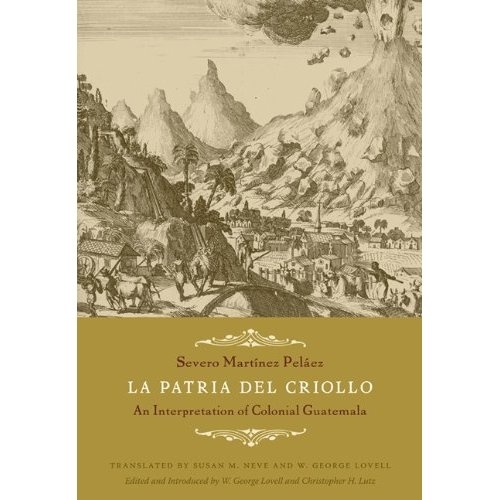
Книга La Patria del Criollo: An Interpretation of Colonial Guatemala
A history of colonial Guatemala, first published in that country in 1970, makes a classic, controversial work of Latin American history available to English-language readers
This translation of Severo Martínez Peláez’s La Patria del Criollo, first published in Guatemala in 1970, makes a classic, controversial work of Latin American history available to English-language readers. Martínez Peláez was one of Guatemala’s foremost historians and a political activist committed to revolutionary social change. La Patria del Criollo is his scathing assessment of Guatemala’s colonial legacy. Martínez Peláez argues that Guatemala remains a colonial society because the conditions that arose centuries ago when imperial Spain held sway have endured. He maintains that economic circumstances that assure prosperity for a few and deprivation for the majority were altered neither by independence in 1821 nor by liberal reform following 1871. The few in question are an elite group of criollos, people of Spanish descent born in Guatemala; the majority are predominantly Maya Indians, whose impoverishment is shared by many mixed-race Guatemalans.
Martínez Peláez asserts that “the coffee dictatorships were the full and radical realization of criollo notions of the patria.” This patria, or homeland, was one that criollos had wrested from Spaniards in the name of independence and taken control of based on claims of liberal reform. He contends that since labor is needed to make land productive, the exploitation of labor, particularly Indian labor, was a necessary complement to criollo appropriation. His depiction of colonial reality is bleak, and his portrayal of Spanish and criollo behavior toward Indians unrelenting in its emphasis on cruelty and oppression. Martínez Peláez felt that the grim past he documented surfaces each day in an equally grim present, and that confronting the past is a necessary step in any effort to improve Guatemala’s woes. An extensive introduction situates La Patria del Criollo in historical context and relates it to contemporary issues and debates.
"“[P]robably the most influential historical analysis of the colonial Guatemalan experience published in Spanish in the last 40 years, if not necessarily within, then certainly beyond the academic world. Long a staple in Guatemalan classrooms and on graduate reading lists elsewhere, in translation it deserves to gain a second life in English language universities as a provocative introduction for sophisticated undergraduates and other non-specialists to the ‘reality’ alluded to in the title of the Spanish original and, perhaps as much, to the distinctive historiographical moment in which it first emerged. Scholars of Central American history and historiography, meanwhile, will appreciate the editors’ extended and thoughtful introduction. . . .”" - A Contracorriente
"“As the Spanish text became fundamental to Guatemalan historiography, this translation will become a staple of Latin American historiography.”" - The Americas
"“In Mariátegui, Martínez Peláez found a kindred spirit. Together they form part of a genealogy of Latin American radical though that, across the twentieth century, confronted the so-called ‘Indian problem’ as a central challenge to Latin American nation-states. For this reason, then, as well as for the importance and drama of Guatemalan history across this same century, the English edition of this book is both welcome and long overdue.”" - American Historical Review
"“Severo Martínez Peláez’s La Patria del Criollo is perhaps the single most influential work about colonial Guatemala written by a Guatemalan historian. . . . Its translation and publication in English will prove propitious if it encourages a new generation of scholars to revisit his vigorous assertions.”" - Colonial Latin American Historical Review
"“Translators Susan M. Neve and W. George Lovell have done an admirable job bringing the true spirit of Martínez Peláez's theories alive for English readers. In addition to the translated text, editors Lovell and Christopher H. Lutz include a useful introduction providing readers unfamiliar with La Patria or its author an understanding of the man as well as the era in which he lived. Furthermore, the editors do a nice job detailing Martínez Peláez's more controversial arguments and their impact on Guatemalan historiography. . . . Graduate students and faculty alike will find value in this work. Summing Up: Highly recommended. Upper-division undergraduates and above.”" - Choice
"English-speaking social science scholars should highly value the English edition of La Patria del Criollo: An Intepretation of Colonial Guatemala, which explains with precision why Latin America still exhibits today the deepest social and economic inequity in the world. Severo Martinez's masterpiece has played a significant role in shaping Guatemalan national and even Latin American regional politics for almost 40 years. It is a profound analysis of the social and political structures that were established during the Spanish colonial period, factors that led to the concentration of power, both economic and poltical, in very few hands." - Canadian Journal of Latin American and Caribbean Studies