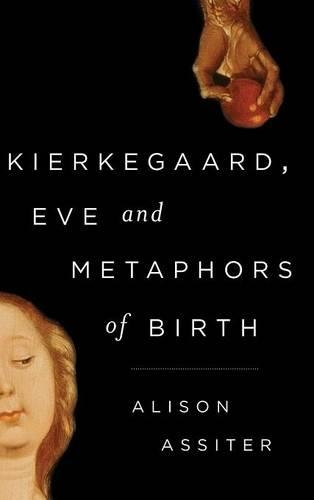
Книга Kierkegaard, Eve and Metaphors of Birth
There has been a recent revival of interest in reading Kierkegaard as an ontologist, as a thinker who engages with questions about the kinds of entity or process that constitute ultimate reality. This new way of reading Kierkegaard stands alongside a revival of interest in ontology and metaphysics more generally. This highly original book concentrates on the claim that Kierkegaard focuses in part on ontological questions and on issues pertaining to the nature of being as a whole. Alison Assiter asserts that Being, for Kierkegaard, following Schelling, can be read in terms of conceptions of birthing—the capacity to give birth as well as the notion of a birthing body. She goes on to argue that the story offered by Kierkegaard in The Concept of Anxiety about the origin of freedom connects with a birthing body, and that Kierkegaard offers a speculative hypothesis, in terms of metaphors of birthing, about the nature of Being.
"The best of this book comes when the philosophy spills over into other areas: the tangle between ecology, ontology and feminism; the bold repurposing of 21st-century realisms; the ethical rejection of a metaphysics of chaos; the whiff of a link between the fiercely religious Kierkegaard and a new vision of the political. Although these sections are all too short, it is here that Assiter’s book is fearless and arresting. Here, she offers a challenge to philosophy’s tendency to recycle old readings and preoccupations, and a timely reminder that philosophy may once again have something to say about the world." - Times Higher Education
"Alison Assiter’s fine monograph is one of several recent attempts in the philosophical literature to challenge contemporary orthodoxy and to revive a picture of nature according to which purposive behaviour belongs to things themselves … Assiter is to be applauded for daring to talk seriously about ‘Being-with-a-capital-B’. She poses a challenge to those whose (scientistic) faith forbids such a move, and exposes the shortcomings of ‘arguments’ which purport to show that reality is, at its deepest core, contingent or chaotic … [She] leaves the reader with a wealth of fascinating questions." - Philosophy
"[A] book that itself marks a rupture with the orthodoxy of existing Kierkegaard studies, drawing out its resonances for contemporary feminisms and new materialisms, and giving birth to the possibility of a new Kierkegaard, born from a contemporary yearning." - Radical Philosophy