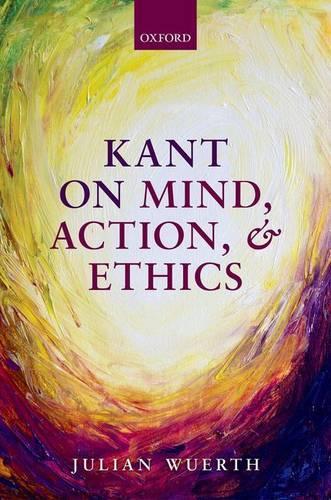
Книга Kant on Mind, Action, and Ethics
In this book Julian Wuerth offers a radically new interpretation of Kant's theories of mind, action, and ethics. As the author of a Copernican revolution in philosophy, Kant grounded his philosophy in his positive theory of the mind, which remains an enigma two centuries later. Wuerth's original interpretation of Kant's theory of mind consults a far wider range of Kant's recorded thought than previous interpretations, revealing a fascinating evolution in Kant's thought in the decades before and after his 1781 Critique. Starting in the 1760s, Kant recognized the unique status of our epistemic contact to ourselves. This is the sole instance of our immediate epistemic contact with a substance, of being a substance, and it is the sole instance of epistemic contact with something other than the particular states of inner sense. Contrary to empiricists, Kant thus rejects the reduction of the self to a bundle of mental states of inner sense. But Kant also rejects the rational psychologists' assumption that the souls substantiality and simplicity implies its permanence, incorruptibility, and immortality. As Kant developed his transcendental idealism, he eventually pinpointed the source of their errors, a source neither unique to a particular, historical school, nor random. It is instead a deep, natural, and timeless transcendental confusion. Kants new account of substance allows him to draw new distinctions in kind between sensibility and understanding and between phenomenal and noumenal substance, setting the stage for a transcendental argument that only at the phenomenal level do substantiality and simplicity imply permanence and incorruptibility. Wuerth next undertakes a groundbreaking study of Kant's theory of action and ethics. He first maps Kant's notoriously vast and complex system of the minds powers, drawing on all of Kant's recorded thought. This system structures Kant's philosophy as a whole and so provides crucial insights into this whole and its parts, including Kant's theory of action, a persisting stumbling block for interpreters of Kant's ethics. Wuerth demonstrates that Kant rejects intellectualist theories of action that reduce practical agents to pure reason. We are instead irreducibly both intellectual and sensible, exercising a power of choice, or Willkür, subject to two irreducible conative currencies, moral motives and sensible incentives, as Kant makes clear long before his 1785 Groundwork. Immoral choices at odds with the former can thus nonetheless be coherent choices in harmony with the latter. Wuerth applies these new findings about Kant's theory of mind and action to an analysis of the foundations of Kant's ethics. He rejects the dominant constructivist interpretation in favor of a moral realist one. At the heart of Kant's Enlightenment ethics is his insistence that the authority of the moral law ultimately rests in our recognition of its authority. Kant guides us to this recognition of the authority of the moral law, across his works in ethics and his various formulations of the moral law, using a single elimination of sensibility procedure. Here Kant systematically rejects the pretenses of sensibility to isolate reason and its insights into moral right and wrong. Precisely because immoral choice remains a coherent alternative, however, moral virtue demands our ongoing cultivation of our capacities for cognition, feeling, desire, and character.
"This title is a hefty read, no doubt, but I recommend it to those who have interests in Kant's philosophy and also to those who possess interests in philosophy of mind more broadly." - Bradford McCall, The Review of Metaphysics
"[F]or those of us hungry to expand our appreciation of Kant's corpus overall, this book is a gold-mine of little noted yet deeply significant texts. The work Wuerth has done to comb carefully through long texts and really get to the heart of what is important philosophically about them reveals itself in these many pages. Along the way, he challenges us to accept the apparently (but not actually) un-Kantian ideas that the self is a substance and that the sensible and the intellectual have something approaching equal standing in Kant's theory of action. So, to reiterate: I recommend this book highly." - Jeanine M. Grenberg, Notre Dame Philosophical Reviews
"[Wuerth] offers a wealth of neglected material from the broader Kant corpus. This is a fresh and ambitious interpretation of Kant, exhaustively and confidently defended" - Kelly Sorensen, Journal of the History of Philosophy