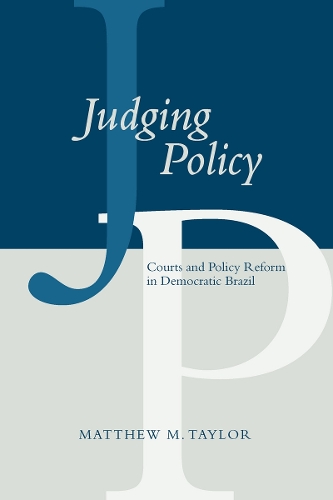
Книга Judging Policy: Courts and Policy Reform in Democratic Brazil
Courts, like other government institutions, shape public policy. But how are courts drawn into the policy process, and how are patterns of policy debate shaped by the institutional structure of the courts?
Drawing on the experience of the Brazilian federal courts since the transition to democracy, Judging Policy examines the judiciary's role in public policy debates. During a period of energetic policy reform, the high salience of many policies, combined with the conducive institutional structure of the judiciary, ensured that Brazilian courts would become an important institution at the heart of the policy process. The Brazilian case thus challenges the notion that Latin America's courts have been uniformly pliant or ineffectual, with little impact on politics and policy outcomes.
Judging Policy also inserts the judiciary into the scholarly debate regarding the extent of presidential control of the policy process in Latin America's largest nation. By analyzing the full Brazilian federal court system—including not only the high court, but also trial and appellate courts—the book develops a framework with cross-national implications for understanding how courts may influence policy actors' political strategies and the distribution of power within political systems.
"Judging Policy is essential reading for those interested in the winding paths of policy reform in Latin America, and a major contribution to the scholarly debate over majority-minority relations and executive-legislative bargaining in the region's largest democracy." - University of São Paulo
"Judging Policy is an excellent contribution to the emerging literature on comparative judicial politics. Taylor's book uses rich empirical material on a consequential and little known actor, the Brazilian court system, to explore a number of theoretical issues that have not yet received their deserved attention." - University of Texas at Austin
"Judging Policy is an extremely important contribution to the emerging literature on the political role of judiciaries in Latin America. Taylor combines a sophisticated and nuanced understanding of Brazilian politics, policy-making, and judicial operations with innovative analytic techniques to reach his conclusions on the political uses of Brazil's courts and the implications for other national systems. Beyond its obvious significance for Brazilianists and those concerned with judicial development, the work is essential reading for anyone interested in the changing relations among the traditional branches of government and the issues they pose for governance in the present century." - World Bank