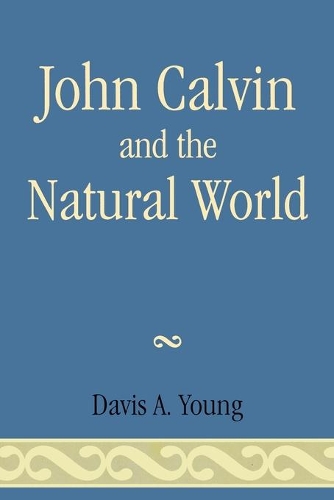
Книга John Calvin and the Natural World
This work focuses on a rarely noted side of the Protestant reformer John Calvin: the theologian as a man appreciative of the details of God's creation, an admirer of those who investigate nature, and a leader that accepted their discoveries and conclusions. John Calvin and the Natural World explores the content of Calvin's scientific outlook by reviewing his views on the structure of the cosmos; the nature of matter and motion; weather; the age, shape, place, and history of the Earth; and the behaviors and characteristics of animals, plants, the human body, and disease. Also drawn out, are the classical, biblical, and medieval influences on Calvin's ideas about nature. Professor Davis A. Young concludes the work with a discussion of Calvin's attitudes, practices, and ideas with respect to science in comparison to how these ideas are carried out in the contemporary church. Professor Young surmises that the judicious application of Calvin's principle of accommodation would help the church to deal in a more thoughtful and balanced way in respect to science and nature, and to defuse some of the rancorous debates surrounding the age of the Earth, flood geology, and evolution.
"This book is comprehensive in terms of Calvin's thinking about creation, nature, and the world. It is indeed a groundbreaking contribution." - American Scientific Affiliation
"This book on Calvin's view of the role of science is relevant for today's ongoing debates between science and Christianity. . . . Young's discussion on the principle of accomodation is a very helpful way to hold both the claims of Scripture and the current conclusions of science." - Christian Scholar's Review, Spring 2009
"Young gives a thorough analysis of Calvin's views about nature and its phenomena in relation to his theological thinking. . . . Young deserves full marks to the work he did in order to get a clear understanding of Calvin's view of the natural world. I hope this well written book will definitely wipe out all 'pseudo-scientific nonsense' about the French Reformer and the sciences." - Journal of Reformed Theology