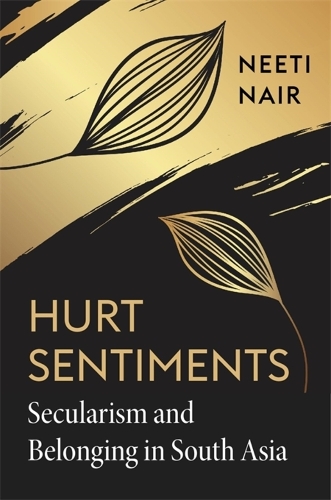
Книга Hurt Sentiments: Secularism and Belonging in South Asia
An insightful history of censorship, hate speech, and majoritarianism in post-partition South Asia.
At the time of the India-Pakistan partition in 1947, it was widely expected that India would be secular, home to members of different religious traditions and communities, whereas Pakistan would be a homeland for Muslims and an Islamic state. Seventy-five years later, India is on the precipice of declaring itself a Hindu state, and Pakistan has drawn ever narrower interpretations of what it means to be an Islamic republic. Bangladesh, the former eastern wing of Pakistan, has swung between professing secularism and Islam.
Neeti Nair assesses landmark debates since partition—debates over the constitutional status of religious minorities and the meanings of secularism and Islam that have evolved to meet the demands of populist electoral majorities. She crosses political and territorial boundaries to bring together cases of censorship in India, Pakistan, and Bangladesh, each involving claims of “hurt sentiments” on the part of individuals and religious communities. Such cases, while debated in the subcontinent’s courts and parliaments, are increasingly decided on its streets in acts of vigilantism.
Hurt Sentiments offers historical context to illuminate how claims of hurt religious sentiments have been weaponized by majorities. Disputes over hate speech and censorship, Nair argues, have materially influenced questions of minority representation and belonging that partition was supposed to have resolved. Meanwhile, growing legal recognition and political solicitation of religious sentiments have fueled a secular resistance.
"A sweeping, vital account of secularism, belonging, and minority religious politics…brave and visionary." - Journal of Church and State
"Neeti Nair’s seminal work is bookended by one of the most significant issues of our times: the contentious and divisive Citizenship Amendments Bill…Its vast sweep of history, dating back to pre-Independence, straddles the space that sits between erudition and expatiation as well as reflection and retelling without descending into pedagogy and pamphleteering." - The Tribune
"Nairʼs careful and comparative approach prompts us to be discerning about the narratives we encounter and to pay close attention to whose sentiments are being protected and whose silenced." - Reading Religion
"This is an important book for all looking at the past to seek answers to what is going on in South Asia at present." - The Telegraph
"Explores how secularism impacted state ideology in the decades after Partition in India, Pakistan, and Bangladesh…Brilliant." - Frontline
"Probably the most important and notable book on South Asian constitutional and political history this year." - Friday Times
"A timely reminder that ascendant expressions of intolerance in South Asia are not aberrations…By exploring the connected historical causes of its current embattled state in India, Pakistan and Bangladesh, Hurt Sentiments stands out as an original work of research that has much to offer to scholars of South Asian history and politics." - South Asian Review
"Represents a notable addition to the scholarly discourse on the evolving dimensions of secularism. This intellectual history work delves into the foundational and early years of the South Asian states, providing valuable insights into the complex interplay between secularism, identity and belonging. …This is an essential read." - The News
"
This insightful and extensively researched book is as timely as it is relevant to the current political moment…By taking stock of the life and fate of this indigenously inflected secularism over a
seventy-five-year period, Nair highlights the intellectual debates, individual political players, and the different historical moments that shaped the status of minority rights in the subcontinent.
"[Nair is] able to simultaneously address those uninitiated in the politics of Hindu majoritarianism and minority communalism with a thought-through and riveting text, as well as provide food for contemplation for those who track the rise of divisive politics in India and its neighbours." - Business Standard
"A wide-ranging exploration of the many ways in which ‘hurt sentiments’ have been weaponised to disenfranchise and ghettoise religious minorities not just in India but across the subcontinent…Compelling." - Indian Express
"Richly layered and draw[s] upon a wealth of details…The real story—and this is indeed the novelty and strength of Nair’s book—is how Gandhi’s death, and Godse’s defence in court shaped post colonial secularism, and the way in which minority rights were framed." - Biblio
"Provides helpful detail about parliamentary and constitutional debates in Bangladesh, India and Pakistan to show how majoritarian parties and interests mobilized and expanded the scope of ‘hurt sentiments’ to marginalize minorities…A valuable resource for students and scholars of South Asia." - Asian Affairs
"An important contribution…Give[s] critical insights into the ideology and practices of South Asian secularists and their role in the weakening of secularism as a political force in the region." - Indian Economic and Social History Review
"If defining concepts is an attempt to make our societies livable, it is a task worth to be taken. Nair does a remarkable job of showing how South Asian lawmakers navigated it. The book provides insights into what happened at the founding moments that influence the trajectory of the political life in the nation and its constituent elements, notably the marginalized." - Doing Sociology
"The strength of the book is its historical detail and its comparative work. Nair maps out in great detail how each of these three nations — India, Pakistan and Bangladesh, begin with secularism as an ideology of the state." - Book Review