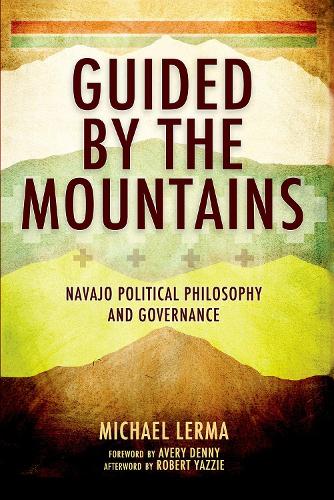
Книга Guided by the Mountains: Navajo Political Philosophy and Governance
What do traditional Indigenous institutions of governance offer to our understanding of the contemporary challenges faced by the Navajo Nation today and tomorrow? Guided by the Mountains looks at the tensions between Indigenous political philosophy and the challenges faced by Indigenous nations in building political institutions that address contemporary problems and enact "good governance." Specifically, it looks at Navajo, or Diné, political thought, focusing on traditional Diné institutions that offer "a new (old) understanding of contemporary governance challenges" facing the Navajo Nation. Arguing not only for the existence but also the persistence of traditional Navajo political thought and policy, Guided by the Mountains asserts that "traditional" Indigenous philosophy provides a model for creating effective governance institutions that address current issues faced by Indigenous nations. Incorporating both visual interpretations and narrative accounts of traditional and contemporary Diné institutions of government from Diné philosophers, the book is the first to represent Indigenous philosophy as the foundation behind traditional and contemporary governance. It also explains how Diné governance institutions operated during Pre-Contact and Post-Contact times. This path-breaking book stands as the first-time normative account of Diné philosophy.
"I was delighted to be offered the opportunity to read and review this wonderful bookThe book is beautifully typeset with many photographs and prints...What sets Carroll's recreational mathematics apart from his more erudite contributions is not that they are childish but that they are "aimed at the non-mathematician, thereby making them accessible to all" - Sara L. Uckelman, Department of Philosophy, Durham University, The British Society for Literature and Science
"This creatively organized volume focuses on a version of Dine (Navajo) philosophy that has been understudied, adding yet another dimension to the vitality, dignity, and utility of Dine values, principles, and landscapes. This world view, according to the author, may guide us to a more humane and sensible approach to good governance."" - David Wilkins, McKnight Presidential Professor of American Indian Studies, University of Minnesota
"In this important book, Michael Lerma explores the complexities of Diné knowledge and philosophy and their practical value as principles of governance. Lerma's skill as a scholar is unequaled. I can think of no other study of Indigenous peoples that has explained the intricacy of Native American, particularly Diné, relations with the spirit world, the elements of place and their political implications as well. It is truly a book like no other."" - Tom Holm, Professor Emeritus, University of Arizona