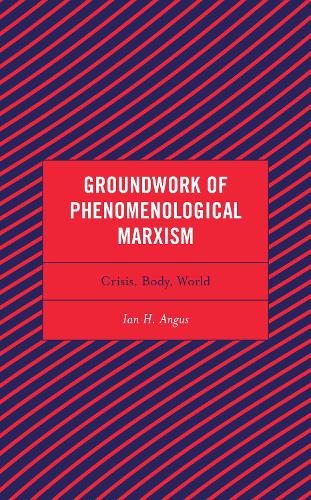
Книга Groundwork of Phenomenological Marxism: Crisis, Body, World
In Groundwork of Phenomenological Marxism: Crisis, Body, World, Ian H. Angus investigates the crisis of reason in a contemporary context. Beginning with Edmund Husserl’s The Crisis of the European Sciences and Transcendental Phenomenology, Angus connects the phenomenology of human motility to Marx’s ontology of labor in Capital and shows its basis in natural fecundity (excess). He argues that the formalization of reason creates an inability to foster differentiated community as expected by both Husserl and Marx and that the formalization of human motility by the regime of value reveals the ontological productivity of natural fecundity, showing that ecology is the contemporary exemplary science. Addressing the crisis requires a philosophy of technology (especially digital technology) and a dialogue between cultural-civilizational lifeworlds, which surpasses Husserl’s assumption that Europe is the home of reason. Angus’s overall conception of phenomenology is Socratic in that it is concerned with the presuppositions and applications of knowledge-forms in their lifeworld grounding. He further shows that the contemporary event is the epochal confrontation between planetary technology and place-based Indigeneity. This book lays out the fundamental concepts of a systematic phenomenological Marxian philosophy.
"
Angus creates a dialogue between Edmund Husserl and Karl Marx heavily informed by the work of Herbert Marcuse and the Frankfurt School. According to Angus, the "the crisis of European sciences" that concerned Husserl and the alienation of the worker from his labor that animated Marx are rooted in the same stifled and limited view of reason and rationality. This being the case, Husserl's phenomenology can be appealed to by Marxian thinkers, and Marx can add depth and texture to Husserl's more formal philosophizing. The point of this book, however, is not merely to negotiate the relationship between two long-dead philosophers but also to show how this "phenomenological Marxism" can assist in thinking through current debates and crises, most notably climate change and its attendant woes. The book is densely argued and calls for a careful, thorough reading. Readers should be familiar not only with Husserl and Marx but also with Feenberg, Habermas, Heidegger, and Marcuse. Recommended. Graduate students, researchers, faculty.
" - Choice Reviews"
It is a welcome addition to our intellectual life and provides an important way in which to address the manifold contemporary crises our world faces. In particular, Angus presents a compelling model wherein we engage with Indigenous and community-based thinking not to simply affirm the “otherness” of this thought, but to see it as an important interlocutor with European phenomenology and Marxism.
" - Phenomenological Reviews"
To conclude, Angus’s book is a profound attempt, executed with outstanding erudition, to creatively confront the contemporary crisis of global civilization through the lens of a unique synthesis of Marx and Husserl. As a phenomenological recovery of Marx’s ontology of labor, oriented toward new horizons in ecological thought, it makes a fundamental contribution and will be a necessary reference point for all future work on this thematic…. I hope this extraordinary book will open up a new discussion of Husserl’s relation to Marx and renew interest in the largely lost tradition of phenomenological Marxism, both of which will be necessary for an even more fundamental challenge to the intellectual roots of our present crisis.
" - Human Studies