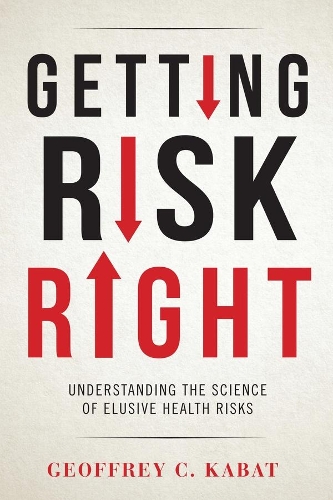
Книга Getting Risk Right: Understanding the Science of Elusive Health Risks
Do cell phones cause brain cancer? Does BPA threaten our health? How safe are certain dietary supplements, especially those containing exotic herbs or small amounts of toxic substances? Is the HPV vaccine safe? We depend on science and medicine as never before, yet there is widespread misinformation and confusion, amplified by the media, regarding what influences our health. In Getting Risk Right, Geoffrey C. Kabat shows how science works—and sometimes doesn't—and what separates these two very different outcomes.
Kabat seeks to help us distinguish between claims that are supported by solid science and those that are the result of poorly designed or misinterpreted studies. By exploring different examples, he explains why certain risks are worth worrying about, while others are not. He emphasizes the variable quality of research in contested areas of health risks, as well as the professional, political, and methodological factors that can distort the research process. Drawing on recent systematic critiques of biomedical research and on insights from behavioral psychology, Getting Risk Right examines factors both internal and external to the science that can influence what results get attention and how questionable results can be used to support a particular narrative concerning an alleged public health threat. In this book, Kabat provides a much-needed antidote to what has been called "an epidemic of false claims."
"An important study that teaches how to decipher science and medical news." - Library Journal
"It is not easy feat to take complex issues and make them both understandable, easily readable and interesting, but Kabat does just that in Getting Risk Right. For people who are trying to sort through the deluge of conflicting information that we see every day, this book is a must." - American Council on Science and Health
"[Kabat issues] a call to arms, urging his fellow scientists, policy makers, and the media to rescue the science of environmental risks from what he presents as its current sorry state. . . . [An] insider’s dissection of the psychology of how environmental studies are funded, reported, and interpreted by their authors and by various audiences." - Washington Post
"Excellent.... A potent antidote to the toxic misinformation polluting our public health discourse." - Reason
"This book will provide you with defensive armor against alarmist headlines and it will help you judge the credibility of new studies. Highly recommended." - Science-Based Medicine
"This is an important book that can help people working in many areas of health." - Health Affairs
"[Getting Risk Right] presents important topics for consideration and four fascinating and well-documented case studies. It is well suited for use in an introductory epidemiology class, where sections or chapters could be assigned as introductory reading by in-depth discussion." - Issues in Science and Technology
"An invaluable new book...useful for any individual teaching or practicing in the health sciences, as well as individuals in education and public health." - Choice
"Highly readable and informative." - Genetic Literacy Project
"A valiant attempt to help us distinguish between real advances and unabashed efforts to scare us. If you are interested in penetrating the massive confusion surrounding health risks in the environment, this pithy book provides an indispensable primer." - Science 2.0
"[An] excellent and informative book." - Skeptical Inquirer