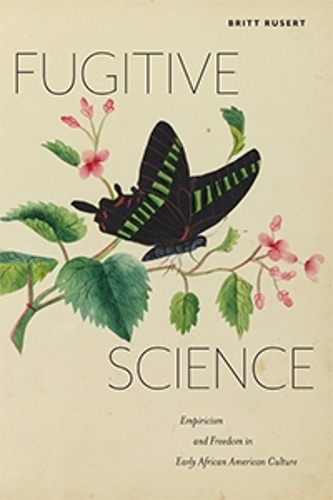
Книга Fugitive Science: Empiricism and Freedom in Early African American Culture
Honorable Mention, 2019 MLA Prize for a First Book
Sole Finalist Mention for the 2018 Lora Romero First Book Prize, presented by the American Studies Association
Exposes the influential work of a group of black artists to confront and refute scientific racism.
Traversing the archives of early African American literature, performance, and visual culture, Britt Rusert uncovers the dynamic experiments of a group of black writers, artists, and performers. Fugitive Science chronicles a little-known story about race and science in America. While the history of scientific racism in the nineteenth century has been well-documented, there was also a counter-movement of African Americans who worked to refute its claims.
Far from rejecting science, these figures were careful readers of antebellum science who linked diverse fields—from astronomy to physiology—to both on-the-ground activism and more speculative forms of knowledge creation. Routinely excluded from institutions of scientific learning and training, they transformed cultural spaces like the page, the stage, the parlor, and even the pulpit into laboratories of knowledge and experimentation. From the recovery of neglected figures like Robert Benjamin Lewis, Hosea Easton, and Sarah Mapps Douglass, to new accounts of Martin Delany, Henry Box Brown, and Frederick Douglass, Fugitive Science makes natural science central to how we understand the origins and development of African American literature and culture.
This distinct and pioneering book will spark interest from anyone wishing to learn more on race and society.
"Antebellum African-Americans, as Britt Rusert has shown, boldly challenged the racist science of their day by drawing on Charles Darwins new evidence that all humans share a common ancestor...Just as the movements to remove Confederate statues, or those of British colonial rulers, force us to re-examine officially sanctioned versions of history, so the movement to topple monuments to racist scientists offers an opportunity to rewrite the histories of science." - The Guardian
"Imaginative and based on rich interdisciplinary research, Ruserts book resurrects an important, neglected story about race and oppositional science in the antebellum US." - Choice
"Rusert has produced a compelling initial foray into fugitive science that will prove useful for scholars studying science in the United States and beyond." - The Journal of Southern History
"Britt Rusert’s Fugitive Science: Empiricism and Freedom in Early African American Culture is an important counternarrative to the history of nineteenth-century scientific racism in the United States. Rusert turns to famous and forgotten African Americans who developed empirical protocols in spaces apart from the institutions that excluded them." - The Year’s Work in Critical and Cultural Theory
"The breadth of Rusert’s archive is impressive, and she combines careful attention to these materials with a theorization of intricate connections between politics, science, and literary and visual representation across the whole nineteenth century. The result is a lucid and expansive study that makes an outstanding contribution to the histories of literature, science, and African American culture." - American Literature to 1900