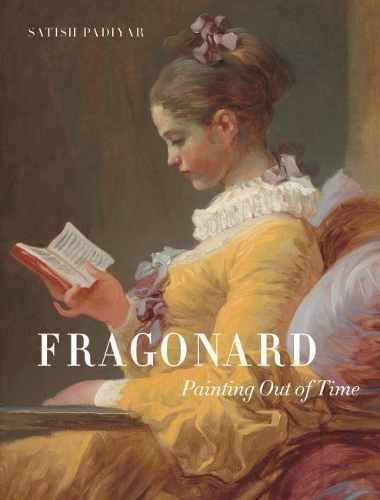
Книга Fragonard: Painting out of Time
At the time of his death in 1806, the Rococo artist Jean-Honore Fragonard had not painted for two decades. Following a period of huge public success, the painter's reputation fell. Personally secretive, Fragonard created revealing images that undermined a normal sense of space and time. Satish Padiyar investigates the life and work of the last of the libertine painters of the ancien regime, a contemporary of Denis Diderot and Jean-Jacques Rousseau, and presents dramatic new perspectives on works such as The Progress of Love, painted for Madame du Barry, the infamous The Bolt and the ever-popular The Swing.
"What might cause an artist to quit? Perhaps the most famous example is Marcel Duchamp, who gave up making Dadaist art circa 1920 to play chess full-time. But Duchamp’s case was somewhat predictable—do enough “anti-art” and the whole project might begin to seem a bit pointless. For the eighteenth-century rococo artist Jean-Honorée Fragonard, however, the situation was more regrettable. Fragonard spent much of his life as a fashionable painter of genre decorations for members of the French aristocracy, but when these patrons began losing their heads in 1789, Fragonard lost his commissions. Never quite able to make the transition over to a more democratic kind of painting, Fragonard put his brushes down for the last time sometime in the early 1790s. Padiyar takes this moment as the starting point of his new investigation into Fragonard’s life and work, which focuses especially on the artist’s innovations in the field of drawing." - New Criterion
"The book is a thorough exploration, painting a picture of how he came to be and how his legacy lives on in contemporary culture. A book worth buying very much for the imagery, which is splashed onto pages with intense colours." - Connexion
"Padiyar argues that the key to the mysteries of Jean-Honoreì Fragonard’s life and work lies in the artist’s relationship to time. According to Padiyar, Fragonard (1732–1806) was 'out of time'—a belated master of a playful rococo idiom of surprise and instability... Padiyar’s book weaves in and out of Fragonard’s career, always tightly focused on the artist’s motivations and personality. In making his argument the author privileges formal analysis, supported by biographical evidence and strategic reference to eighteenth-century art theory and philosophy. Written in stylish, sophisticated prose, the study offers interpretations both of Fragonard’s most famous works and of less-known paintings and drawings. A valuable addition to the literature on eighteenth-century French art and culture. Recommended." - Choice
"Fragonard is a fascinating study and will appeal to specialists and general audiences alike. Padiyar captures the complexities of one of the most recognizable, albeit mysterious, eighteenth-century European artists and presents him in a relatable manner: as an individual trying to make sense of his own place in a society that did not suit him. Throughout his career, Fragonard was stuck in limbo; he fit in neither with the social expectations of the Académie nor with the aristocratic circle of his patrons. He was a bit old-fashioned, only beginning to work in the Rococo style at midcentury, but was also ahead of his time, rebelling against state-sanctioned practices and creating art that, in many ways, anticipated the expressive qualities of late nineteenth-century art making. Indeed, the Fragonard captured by Padiyar is 'out of time,' painting to the proverbial beat of his own drum, struggling to find his niche in the world he inhabits, and creating an oeuvre that brings viewers into an 'out of time, fantasy world.'" - caa.reviews
"This is an outstanding contribution to a field the extent and depth of which are accommodated in a comprehensive bibliography. Its immaculate scholarship testifies to a mastery of earlier writing on Fragonard, whether by his contemporaries or in modern interpretations of the artist’s work. It is hugely enriched by its 114 illustrations. . . . This is a book which is intellectually stimulating and as beautifully written as it is produced." - Journal of European Studies
"Satish Padiyar, tries to get beneath the skin of this elusive painter who apparently preferred artistic freedom to material reward. His task is complicated by a dearth of biographical information. In an age of voluminous correspondence, Fragonard left no letters and no diaries. Even the accounts of his peers are sketchy and possibly misleading. When trying to understand a long-dead artist every biographical fragment is useful, but almost the only clues to Fragonard’s personality are to be discovered in his work. We don’t know what he was thinking when he painted erotic masterpieces such as The Swing (1767) or The Bolt (c.1778), but it’s fascinating to place these works within the cultural context of France in the last years of the ancien régime." - Sydney Morning Herald