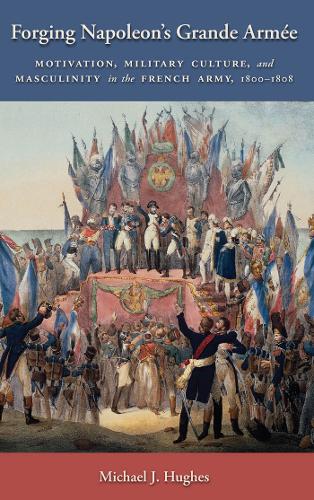
Vividly illustrates how a many-pronged culture gave Napoleon's soldiers reasons to fight
The men who fought in Napoleon’s Grande Armée built a new empire that changed the world. Remarkably, the same men raised arms during the French Revolution for liberté, égalité, and fraternité. In just over a decade, these freedom fighters, who had once struggled to overthrow tyrants, rallied to the side of a man who wanted to dominate Europe. What was behind this drastic change of heart?
In this ground-breaking study, Michael J. Hughes shows how Napoleonic military culture shaped the motivation of Napoleon’s soldiers. Relying on extensive archival research and blending cultural and military history, Hughes demonstrates that the Napoleonic regime incorporated elements from both the Old Regime and French Revolutionary military culture to craft a new military culture, characterized by loyalty to both Napoleon and the preservation of French hegemony in Europe. Underscoring this new, hybrid military culture were five sources of motivation: honor, patriotism, a martial and virile masculinity, devotion to Napoleon, and coercion. Forging Napoleon's Grande Armée vividly illustrates how this many-pronged culture gave Napoleon’s soldiers reasons to fight.
"Michael Hughes, associate professor of history at Iona College, has executed a masterful book on two fronts. TitledForging Napoleon's Grande Armee: Motivation, Military Culture, and Masculinity in the French Army 1800-1808, Hughes's book not only contributes to our understanding of the military success of Napoleon's army, but also elegantly employs cultural history methods to better understand army operations and sustained troop motivations." - History: Reviews of New Books
"Hughes offers a tight and well-grounded exposition and analysis of French military culture in the Napoleonic period in which military honour is presented as a dynamic element." - Journal of European Studies
"Hughes provides an important contribution to the literature concerning Napoleon's ability." - Journal of Interdisciplinary History