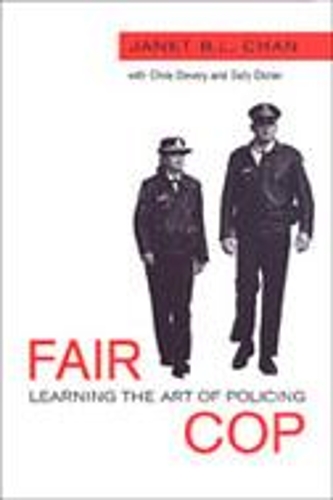
Книга Fair Cop: Learning the Art of Policing
'Fair Cop is the most sophisticated and important study yet of police training. Its unique research approach and findings broaden our understanding of occupational socialization. As such, Fair Cop is a lasting contribution to academic research on the police and to the sociology of organizations and occupations. It is also a valuable resource for those concerned with improving police management and for the field of human resources in general.' -- Richard Ericson, Principal of Green College and professor of Law and Sociology, University of British Columbia 'Fair Cop, one of several fundamental works by Janet Chan on Australian policing and police socialization, is a major work, one of a handful of such quality in the Anglo-American world. It is the only systematic cohort study combining both qualitative and quantitative methods since Van Maanen's some 25 years ago, and draws on fundamental theoretical ideas. The book elaborates with data Bourdieu's ideas to illuminate "occupational culture," "professionalism," "good and bad police work" and the not so obvious tensions between "theory" and "practice," the academy and the job. It shows clearly, with rich examples, longitudinal survey data, and focus group materials, the multi-faceted complexity of active adaptations to police training, apprenticeship, and first few weeks in the field. Chan (with Devery and Doran) shows changes in their attitudes, their views of the work, their training, public expectations, and the utility of modes of coping with new situations. We are now better prepared to ask why policing changes so little.' -- Peter K Manning, E.H. and E.V. Brooks Professor, College of Criminal Justice, Northeastern University
Police forces everywhere have been undergoing major social and organizational changes. In this, one of the few longitudinal studies of police socialization, Janet Chan, Christopher Devery, and Sally Doran present the complexity of police socialization under these changing conditions. Following 150 new police recruits through two years of training and apprenticeship, the authors question the traditional model of socialization that assumes a degree of stability and homogeneity in the organizational culture. They suggest that recruits' developmental paths can be much more varied and police culture is increasingly vulnerable to change. Drawing on interviews, observations, and questionnaires, the authors depict the complex processes by which recruits adapt, redefine, cope with, and make sense of the positive and negative aspects of their training and apprenticeship. Bringing together rigorous quantitative analyses with rich ethnographic description, Fair Cop provides new empirical data and theoretical understanding about the reproduction and change of police culture.