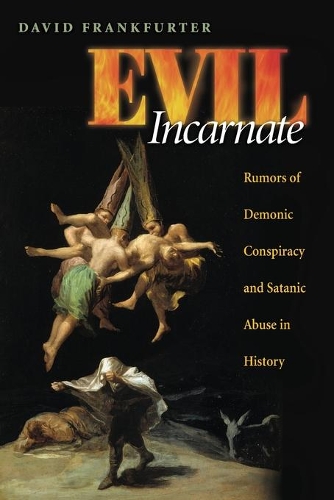
Книга Evil Incarnate: Rumors of Demonic Conspiracy and Satanic Abuse in History
David Frankfurter's valuable, well-written study takes us to the far reaches of demonology. In documenting the harm done by labeling others evil, he poses a challenge to those of us who believe, however regretfully, in the necessity of the concept. -- Robert Jay Lifton, author of "The Nazi Doctors" and "The Genocidal Mentality" David Frankfurter has taken a sensationalist topic and given it a serious, sober, and thoroughly enlightening treatment. At the heart of moral panics--witch crazes, red scares, rumors of Satanic ritual abuse, and others--he perceives not evil as an entity or sinister force, but rather a discourse of evil that draws on old traditions and common fantasies to stimulate horror, shock, and also prurient pleasure. Repeatedly, this volatile mix proves capable of inflaming passions and spawning violent campaigns whose excesses all too predictably fall on society's most marginal, and therefore most vulnerable, members. Drawing on a great many examples and much prior research, he makes a strong--and profoundly moral--argument. -- Bruce Lincoln, University of Chicago David Frankfurter's valuable, well-written study takes us to the far reaches of demonology. In documenting the harm done by labeling others evil, he poses a challenge to those of us who believe, however regretfully, in the necessity of the concept. -- Robert Jay Lifton, M.D., Distinguished Professor Emeritus, City University of New York Challenging the idea of evil being a reality beyond human comprehension, David Frankfurter's sharp and original analysis explores how this very idea produces a terrifying, unsettling reality of its own. The great merit of this elegantly written, substantial book is that it moves us beyond a rather particularistic attitude toward separate, locally bounded cases and shows that there is a system in the variegated realm of evil. -- Birgit Meyer, Free University Amsterdam A significant contribution to several fields including comparative religions, ancient and contemporary religious history, and even literary criticism. Frankfurter's approach--looking at evil not as some force or essence but as a discourse--is highly original. -- Hugh Urban, Ohio State University Engrossing and well-informed, Evil Incarnate presents a cornucopia of amazing material in lucid prose, cogently organized and constructed into an engaging argument. Few authors have the range, the vision, and the boldness to break through the disciplinary and chronological boundaries to bring off a book like this. -- Charles Stewart, University College London
In the 1980s, America was gripped by widespread panics about Satanic cults. Conspiracy theories abounded about groups who were allegedly abusing children in day-care centers, impregnating girls for infant sacrifice, brainwashing adults, and even controlling the highest levels of government. As historian of religions David Frankfurter listened to these sinister theories, it occurred to him how strikingly similar they were to those that swept parts of the early Christian world, early modern Europe, and postcolonial Africa. He began to investigate the social and psychological patterns that give rise to these myths. Thus was born Evil Incarnate, a riveting analysis of the mythology of evilconspiracy. The first work to provide an in-depth analysis of the topic, the book uses anthropology, the history of religion, sociology, and psychoanalytic theory, to answer the questions "What causes people collectively to envision evil and seek to exterminate it?" and "Why does the representation of evil recur in such typical patterns?" Frankfurter guides the reader through such diverse subjects as witch-hunting, the origins of demonology, cannibalism, and the rumors of Jewish ritual murder, demonstrating how societies have long expanded upon their fears of such atrocities to address a collective anxiety. Thus, he maintains, panics over modern-day infant sacrifice are really not so different from rumors about early Christians engaging in infant feasts during the second and third centuries in Rome. In Evil Incarnate, Frankfurter deepens historical awareness that stories of Satanic atrocities are both inventions of the mind and perennial phenomena, not authentic criminal events. True evil, as he so artfully demonstrates, is not something organized and corrupting, but rather a social construction that inspires people to brutal acts in the name of moral order.