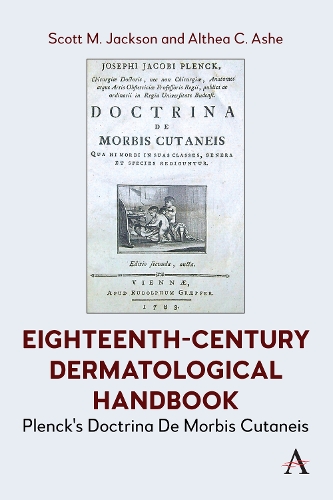
Книга Eighteenth-Century Dermatological Handbook: Plenck's Doctrina De Morbis Cutaneis
Presents the first English translation of Joseph Jacob Plenck’s 1776 handbook, a foundational work that established the morphology-based classification system underlying modern dermatology.
Ever wonder about what an 18th-century physician or surgeon needed to know about skin diseases? For the very first time, the 18th-century handbook, Doctrina de Morbis Cutaneis (1783 edition), has been translated into English. In an effort to distill confusing information about skin diseases into a simple system for his students, Joseph Jacob Plenck (1738–1807)—unknowingly and without any recognition—set the study of skin disease on a path toward formal specialization. Doctrina was the text that inspired Robert Willan (1757–1812) to make his own system; thus, Doctrina is the foundational text of dermatology. In the 250th anniversary of the first edition of this work (1776), it is our intent both to honor Plenck with a translation of his masterful work and to reveal its secrets to modern readers and scholars.
Presents the first English translation of Joseph Jacob Plenck’s 1776 handbook, a foundational work that established the morphology-based classification system underlying modern dermatology.
In 1776, an Austro-Hungarian surgeon named Joseph Jacob Plenck (1738–1807) unknowingly laid the foundation for the coming specialty with a handbook for his students titled Doctrina de Morbis Cutaneis. The title translates from the Latin to “Instruction on Cutaneous Diseases.” For the very first time, this 18th-century handbook has been translated into English. We translated the second Latin edition, published in 1783.
The work represents a milestone in the evolution of how early modern physicians and surgeons viewed skin disease. It contains the first scientific classification of skin diseases according to their appearance. The skin-focused physicians in the generation that followed the publication of this text—especially Robert Willan (1757–1812), widely considered the founder of the specialty of dermatology—built upon the knowledge contained within this foundational text.
Its size was ideal for a handbook—a vade mecum (literally, “go with me”)—a book kept handy by Plenck’s audience, who were medical students and inexperienced surgeons expected to care for patients with skin diseases. In the preface, Plenck acknowledged the challenges faced by his students in learning about skin diseases, stemming from “the great number and the diversity of cutaneous diseases, the obscurity of their causes and differences, as well as the difficulty of treating them.” He claimed that the study of skin diseases was one of the most difficult and most incomprehensible subjects for his students. As a result, his objective, as stated in the preface, was to “reduce this vast and disparate pile of diseases into a system.” Plenck broke ground with his attempt to distill the known information of his time into a morphology-based system. His classification system categorizes 119 skin diseases into 14 categories or “classes,” such as macules, papules, and pustules. Under each class, Plenck offered “genera” and “species.” For example, under the first class, “Maculae,” Plenck created 35 different genera of macules, and each of these genera has 3 to 12 different species. Dermatologists today still use these terms—macules, papules, pustules, crusts, and so on—to describe the primary skin lesions of a skin disease. Doctrina was a groundbreaking, concise, and at the same time comprehensive text that has yet to get the credit it deserves. In an effort to bring order to the chaos of skin disease knowledge for his young pupils, Plenck and his little book unknowingly set dermatology on its path to modernity. For all these reasons, the authors would like to declare Doctrina de morbis cutaneis by Joseph Jacob Plenck to be the true foundational text for modern dermatology.