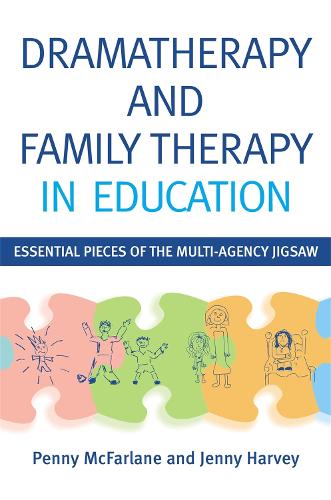
Книга Dramatherapy and Family Therapy in Education: Essential Pieces of the Multi-Agency Jigsaw
A collaborative therapeutic approach often proves the best way to assess and meet the needs of children experiencing barriers to learning. This book gives a concise overview of drama and family therapy and describes how both therapies can work together to provide essential pieces of the jigsaw of emotional support for troubled children within an educational setting.
Drawing on their own extensive experience, the authors give explanations of the models and techniques of their own specialist therapy, before exploring their joint work and innovative inclusion in a cooperative team of multi-disciplinary professionals. The book discusses the principles and protocols of a Multi Agency Support Team and looks at how the pieces come together in practice. Case studies are provided to illustrate the successful outcomes of this way of working, as well as the challenges it can present.
This book will be vital reading for all professionals working alongside children, families and schools, who are interested in addressing the needs of the child on a deeper and more sustainable level.
"
The book is written with professionals that work in multi-agency teams in mind... Both authors are trained therapists... Each author outlines their qualifications and experiences, giving explanations of the models and techniques used.
The initial focus is on dramatherapy, describing who it is for, the history of dramatherapy, how it works and the skills necessary to implement this sort of therapy... Case studies are used to outline theoretical perspectives, psychological models and to illustrate techniques in context.
Following on from this approach the Family Therapy models are discussed... The key skills and therapeutic principles used by the therapists would reflect skills developed and practised as part of the doctoral training for Educational Psychologists. The book would also be relevant to other therapists that work within schools and schools considering the use of these approaches within schools in an age of commissioning. The book illustrates how these therapeutic approaches can feed into and enlighten the process of understanding the world of the child, family functioning and the environments in which they function. Overall, I would advocate the reading of this book as a clear overview of the approaches used in dramatherapy and family therapy. The simplicity of the book structure makes the book easy for busy professionals to 'dip in and out of'. The case studies provide a context to see how these therapeutic approaches could be useful and valid in real-life situations.