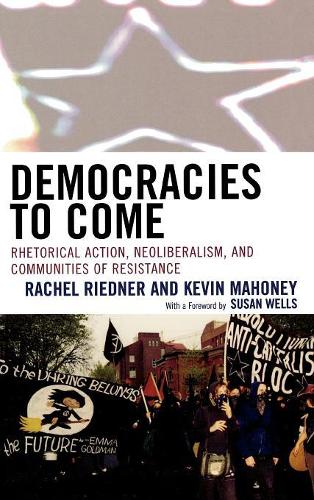
Книга Democracies to Come: Rhetorical Action, Neoliberalism, and Communities of Resistance
Democracies to Come draws upon a variety of contemporary sites and moments (e.g. IMF/World Bank protests, writing emerging from social movements in struggle against neoliberalism, classroom praxis, postcolonial literature, student activism) to explore new relationships—pedagogical, emotional, affective, and social—that can be the basis of political and social organizing. Approaching pedagogy as a space of learning, Democracies to Come argues that pedagogy becomes a cultural force for democracy in its own right, a cultural literacy, which intervenes in a multiplicity of systems, institutions, cultural formations, and constituencies. Each chapter of the book answers these questions: How can pedagogy be conceptualized as a site in which to intervene in culture and to act politically? How can pedagogy help cultivate the kairotic act of opening spaces for inquiring into the social relations that education helps shape? How can we re-imagine practices capable of contextualizing education within larger educational and market forces? How do we develop the desire and habit to recognize moments when we move beyond norms and develop new ways of seeing, acting, and relating? How do we see pedagogical activism not as an end in itself but as an integral process of revitalizing democracy? How can we create moments to process new arguments, respond to particular conjunctures, and create languages that articulate the contingencies and affinities of the particular moment?
"Democracies to Come may prove particularly useful for community engaged educators, activists, and composition scholars as it leaves us with lists of questions that lead to reflective praxis. . . .Whether we work with non-profits or individual community members, in correctional facilities or with activist organizations, Democracies to Come provides ways to understand our everyday work with language as action that has the potential to rupture geo-political and shift geopolitical systems. It provides a path toward critically engaging across the individual and systemic, as well as the local and global, a challenging move because of the neoliberal frameworks which conscribe our work and relationships, but a necessary move if we wish to work toward 'the out to be.'" - Reflections
"Perhaps the most important thing that Democracies to Come accomplishes is to remind rhetors, teachers, and activists to search for the cracks in neoliberal hegemony and transform them into moments of rhetorical action. If the context of the current economic crisis makes this work more urgent, then the narrative hope and change that has also wept the recent national media makes Riedner and Mahoney's project viable as an invitation to kairotic practice in the face of despair." - Rhetoric Review