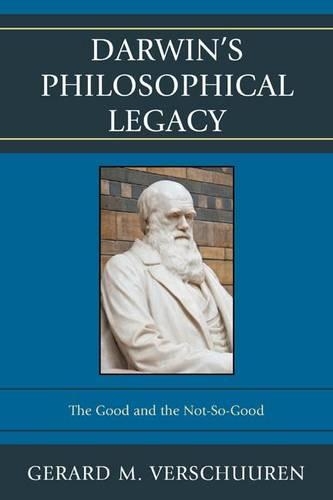
Книга Darwin's Philosophical Legacy: The Good and the Not-So-Good
There is hardly any university, college, or even high school left where they do not teach Darwinism—and rightly so. Yet, most of these places do more preaching than teaching. They teach more than they should, and at the same time, they teach less than they should. Most books on Darwinism are either oriented on biology or philosophy, but this book tries to combine both approaches, so it explains the biological aspects for (future) philosophers as well as the philosophical aspects for (future) biologists. It leaves Darwinism intact, but removes the “sting” that many of its opponents dislike. In what Verschuuren calls “The Good” parts of Darwin’s legacy, the author explores what Darwin’s great contributions are to the study and theory of evolution. At the same time, the book will also delve into the areas where Darwin’s thoughts were not so perfect or even wrong, especially in a philosophical sense – “The Not So Good” parts of his legacy. Almost all books on the philosophy of biology, and neo-Darwinism in particular, were born in the cradle of logical positivism or linguistic analysis. This book, on the other hand, tries to cross the border between the physical and the meta-physical.
"Darwin's philosophical legacy can be found in both the scientific explanatory power of his evolutionary theories and the intense controversies that those theories have created. This binary nature is discussed in the current literature, which is replete with arguments that make attempts to either debunk the legacy's core or elevate that core to a place of prominence. The uniqueness of this latest work is that it takes a balanced approach to understanding the impact of Darwinian theory on contemporary science. Human geneticist Verschuuren accomplishes this with paired chapters that he uses to examine the 'good' and 'not-so-good' parts of Darwin's legacy. Though most works in the genre focus on either the physical or metaphysical components of Darwin's theory, Verschuuren has made an ambitious attempt to bridge the two in a modest number of pages. The result is that no single topic is covered in great depth, but the text's point-counterpoint nature is sufficient to spark further discussion. Readers need background knowledge on both evolutionary theory and epistemology to fully appreciate Verschuuren's arguments. Those familiar with critiques of neo-Darwinian theory will recognize the topics used in organizing the chapters (e.g., reductionism, randomness, purpose, designer, gradualism). Summing Up: Recommended. Upper-division undergraduates and above. " - CHOICE