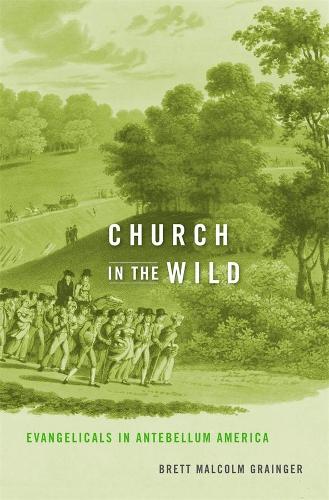
Книга Church in the Wild: Evangelicals in Antebellum America
A religious studies scholar argues that in antebellum America, evangelicals, not Transcendentalists, connected ordinary Americans with their spiritual roots in the natural world.
We have long credited Emerson and his fellow Transcendentalists with revolutionizing religious life in America and introducing a new appreciation of nature. Breaking with Protestant orthodoxy, these New Englanders claimed that God could be found not in church but in forest, fields, and streams. Their spiritual nonconformity had thrilling implications but never traveled far beyond their circle. In this essential reconsideration of American faith in the years leading up to the Civil War, Brett Malcolm Grainger argues that it was not the Transcendentalists but the evangelical revivalists who transformed the everyday religious life of Americans and spiritualized the natural environment.
Evangelical Christianity won believers from the rural South to the industrial North: this was the true popular religion of the antebellum years. Revivalists went to the woods not to free themselves from the constraints of Christianity but to renew their ties to God. Evangelical Christianity provided a sense of enchantment for those alienated by a rapidly industrializing world. In forested camp meetings and riverside baptisms, in private contemplation and public water cures, in electrotherapy and mesmerism, American evangelicals communed with nature, God, and one another. A distinctive spirituality emerged pairing personal piety with a mystical relation to nature.
As Church in the Wild reveals, the revivalist attitude toward nature and the material world, which echoed that of Catholicism, spread like wildfire among Christians of all backgrounds during the years leading up to the Civil War.
"While we sometimes attribute an enlightened ecology to the New England Puritans, [Grainger] shows how the many millions of evangelicals of the same period had a similar sensibility. The book shows what an approach to religion that strays from the titanic intellectuals and texts can do. In lieu of a rereading of Thoreau, Grainger offers us a fine-grained account of the hymns, sermons, and poetry that constituted the commonsense worldview of a people." - Boston Review
"Grainger…demonstrates in his trenchant debut that the American spiritualist origin story of Transcendentalists seeking the divine in the woods and fields doesn’t hold up…Readers of American history and Christian theology will enjoy Grainger’s history, and fans of Emerson and Thoreau will find much to intrigue and challenge them." - Publishers Weekly
"Evangelicals today may be relatively out of tune with the environment and sanguine about what is happening to it. But as Brett Grainger shows in this timely work, they have not always been insensitive to communications from nature…Succeeds wonderfully in conveying the emotional engagement with nature experienced by antebellum evangelicals and the sparkling quality of their religiosity." - Church History
"In Grainger’s work, contemporary Christians might find a resource for understanding themselves as nature worshipers, and thus also as potential stewards of that nature…Through a focus on the nature motifs that pervaded evangelical piety, Grainger points to the fundamental eclecticism of American evangelical history." - Reading Religion
"Readers discover a portrait of early American lived religion that centers [on] the great outdoors. If we have often ceded the natural world to histories of unorthodox, elite seekers such as the New England Transcendentalists, we lose sight of a wider range of religious and cultural experiences in which religious people made sense of their surroundings." - Anxious Bench
"The original, significant contribution of Grainger’s study is to map in graphic detail the evolution and varieties of religious experience that immersion in the nonhuman world spawned for all sorts and conditions of evangelical believers from this period. The book succeeds admirably…A fresh perspective on the manifold versions of nature reverence in America that flourished in nineteenth-century American beyond the more celebrated ‘Concord philosophy’ of Transcendentalist New Englanders like Emerson and Thoreau." - Journal for the Study of Religion, Nature, and Culture
"Masterful…The implications of this study are significant. Against longstanding scholarly characterizations of Protestants as agents of disenchantment, Grainger highlights the multiplicity of ways in which Evangelicals popularized the idea of divine immanence in nature." - Journal of Ecclesiastical History