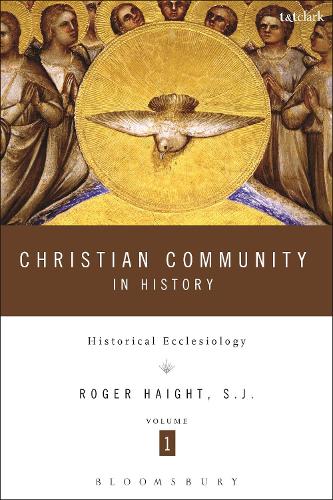
Книга Christian Community in History Volume 1: Historical Ecclesiology
Haight charts the history of the church's self-understandings from the origins of the church in the Jesus movement to the late Middle Ages.
Drawing upon the methodology developed in his Dynamics of Theology (1990) and exemplified in Jesus Symbol of God (1999), Roger Haight, in this magisterial work, achieves what he calls an historical ecclesiology, or ecclesiology from below. In contrast to traditional ecclesiology from above, which is abstract, idealist, and ahistorical, ecclesiology from below is concrete, realist, and historically conscious.
In this first of two volumes, Haight charts the history of the church's self-understandings from the origins of the church in the Jesus movement to the late Middle Ages. In volume 2 Haight develops a comparative ecclesiology based on the history and diverse theologies of the worldwide Christian movement from the Reformation to the present. While the ultimate focus of the work falls on the structure of the church and its theological self-understanding, it tries to be faithful to the historical, social, and political reality of the church in each period.
"After gaining much renown for his Christology from below Haight applies his methodology to ecclesiology. In this first of a projected two-volume ecclesiology from below, Haight traces the history of the church from its beginnings into the late Middle Ages, concluding with a positive assessment of conciliarism.... Recommended." -Choice, 5/05 - Choice
"I salute Haight for the extraordinary accomplishment represented in this two-volume work..."- Richard P. McBrien, Horizons - Horizons
"Haight's comparable efforts to find methods based on a hermeneutics of authors, a hermeneutics of texts, and a hermeneutics of receivers can open up a common ground amidst diverse viewpoints for understanding the church, foster new formulations about the church's identity and mission, and affirm common practices."- Bradford E. Hinze, Religious Studies Review - Religious Studies Review
"[Part of a] landmark work ... Unlike other books on church history or ecclesiology, this is not one with a ‘hidden author’ ... Instead, Haight constantly engages the reader by explaining what he is doing and why he is doing it, and also by introducing topics such as historical consciousness, globalization, religious pluralism, and contemporary secularism." - Reviews in Religion and Theology
"Review in German in Theologische Literaturzeitung 131 (2006)" - Theologische Literaturzeitung