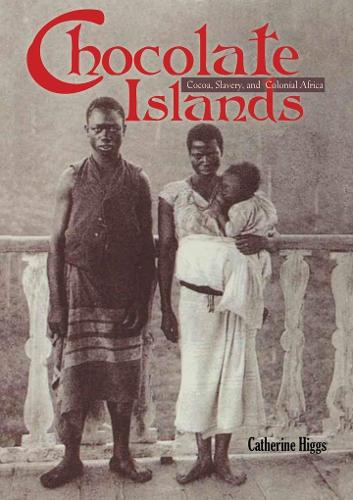
Книга Chocolate Islands: Cocoa, Slavery, and Colonial Africa
In Chocolate Islands: Cocoa, Slavery, and Colonial Africa, Catherine Higgs traces the early-twentieth-century journey of the Englishman Joseph Burtt to the Portuguese colony of São Tomé and Príncipe—the chocolate islands—through Angola and Mozambique, and finally to British Southern Africa.
In Chocolate Islands: Cocoa, Slavery, and Colonial Africa, Catherine Higgs traces the early-twentieth-century journey of the Englishman Joseph Burtt to the Portuguese colony of São Tomé and Príncipe—the chocolate islands—through Angola and Mozambique, and finally to British Southern Africa. Burtt had been hired by the chocolate firm Cadbury Brothers Limited to determine if the cocoa it was buying from the islands had been harvested by slave laborers forcibly recruited from Angola, an allegation that became one of the grand scandals of the early colonial era. Burtt spent six months on São Tomé and Príncipe and a year in Angola. His five-month march across Angola in 1906 took him from innocence and credulity to outrage and activism and ultimately helped change labor recruiting practices in colonial Africa.
This beautifully written and engaging travel narrative draws on collections in Portugal, the United Kingdom, and Africa to explore British and Portuguese attitudes toward work, slavery, race, and imperialism. In a story still familiar a century after Burtt’s sojourn, Chocolate Islands reveals the idealism, naivety, and racism that shaped attitudes toward Africa, even among those who sought to improve the conditions of its workers.
"“Higgs provides a fascinating exploration of the use of forced labor in Portuguese African colonies and the politics of humanitarian investigations in the early 20th century…. This well-written book deserves to be read by scholars of colonial Africa and imperialism. Summing Up: Highly recommended." - Choice
"“Catherine Higgs’s Chocolate Islands: Cocoa, Slavery, and Colonial Africa is an elegantly written, well-illustrated account of the ensuing investigations into this so-called new slavery in Africa orchestrated largely by Cadbury and the British Foreign Office.… [The] study resonates today, dealing, as it does, with the often tainted international origins of our later era of mass consumerism.”" - American Historical Review
"“An excellent study…illustrated by numerous contemporary photographs…. (Joseph) Burtt's correspondence with Cadbury, together with his report and writings, form the basis of a large part of Higgs's skillfully written and important book, which critically reassesses Cadbury's struggle between moral integrity and the need for competitively priced cocoa.”" - African Affairs
"“Higgs's accessible and graceful prose captures the complexities, contingencies, and contradictions of Burtt's voyage…. A fascinating journey approachable for scholars and casual readers.”" - The Historian
"“As the history of a commodity and social movement, Chocolate Islands is useful because it pulls together so many important narratives within African history. It is a worthwhile companion for multiple university applications, from modern Africa courses to world history, or as an excellent example of narrative historical techniques for graduate students.”" - African Studies Quarterly
"“Catherine Higgs has written a marvelous book examining the European dilemma over post-abolition forms of African labor…. Higgs weaves, with eye-opening success, seemingly disparate threads into a single historical landscape.”" - Journal of African History
"“Chocolate Islands is a superb book…. (It) should be read by undergraduates, graduate students, and the general reader who search for an understanding of the complexities of the abolition of slavery and the slave trade, and the incongruities of the labor-recruitment policies of the Portuguese and other European colonizers.”" - Enterprise and Society
"“(Chocolate Islands) takes the reader into the politics, diplomacy, and highly personal interactions among planters, philanthropists, missionaries, journalists, and anti-slavery activists, Portuguese colonial administrators, and authorities in both the British and Portuguese foreign offices…. Higgs’s careful work…adds depth and texture to our understanding of the Chocolate Islands and the turn of the century struggles around highly sought-after cocoa….”" - International Journal of African Historical Studies
"“A considerable contribution to the literature on modern Portuguese colonialism and its Quaker critics”" - H-Net (H-Luso-Africa)
"“Higgs’s book is a reminder of the relevance of African histories to contemporary questions. There are obvious parallels between the serviçais and the factory workers of 21st-century China, or the cleaners and service providers of Dubai. Modern Western democracies may be founded on ideologies of freedom, but they have yet to reconcile these ideologies with what used to be known as the ‘labour question’. The intellectual incoherence of late capitalism emerges nowhere more starkly than in the paradox of the coercive labour regimes needed to facilitate unlimited free consumption.”" - London Review of Books
"“Catherine Higgs has combined careful academic research with the kind of skillful writing you'd expect in a good historical novel… . The book is strikingly relevant to today's headlines. It is an excellent study for academics who want to know how to research at a professional level and then write well for the public, and it will strongly appeal to general readers.”" - Book News
"“A fine, detailed work about the intersection of chocolate and slavery in the first decade of the 20th century.”" - Library Journal
"“Higgs offers a well-researched examination of the dynamics of race, labor, and colonialism in the early part of the twentieth century.”" - Booklist