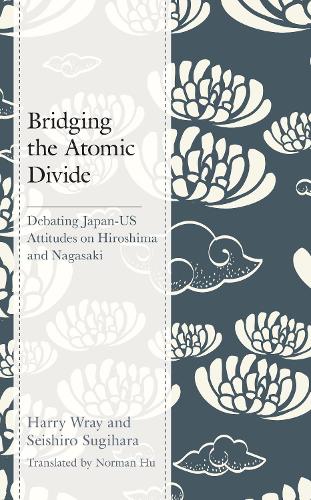
Книга Bridging the Atomic Divide: Debating Japan-US Attitudes on Hiroshima and Nagasaki
Harry Wray and Seishiro Sugihara transcend the one-sided Tokyo Trial view of the war in an effort to conduct a balanced exchange on historical perception. This will be of interest equally to both those inside and outside Japan who are perplexed by Japan’s “victimization consciousness.” Through this impassioned and heartfelt dialogue, Wray challenges theories embraced by some Japanese who believe that the US simply “used the atomic bombings to make the Soviet Union manageable in the Cold War,” as alleged by the Hiroshima Peace Museum and in Japanese school history textbooks. They ask why it is the Japanese people don’t recognize how the atomic bombings not only spared the further sacrifice of American and Japanese lives by accelerating the end of the war, but also prevented a wide-scale Soviet invasion of the Japanese mainland, had the war continued into the latter half of 1945. While early censorship of writings about Hiroshima and Nagasaki, both outright and self-imposed, continued through the Occupation, Sugihara proposes that, long after the Americans had packed up and gone home, the Foreign Ministry established and nurtured a postwar paradigm which rendered open and critical discussion of war-related issues, such as Pearl Harbor and the atomic bombings, impossible for the Japanese public. It is no wonder then that Japanese attitudes towards the atomic bombings remain mired in victimization myths. Uniquely, Wray and Sugihara attempt to persuade the Japanese to reexamine their attitudes to Hiroshima and Nagasaki, to show that the atomic bombings, perversely, brought a swift end to the war and helped Japan escape the act of partition which afflicted postwar Germany and remains an intractable problem in a divided Korea.
"In Bridging the Atomic Divide: Debating Japan–U.S. Attitudes on Hiroshima and Nagasaki, veteran Japan scholars Harry Wray (now deceased) and Seishiro Sugihara consider, in remarkably fine-grained, blow-by-blow detail, the events of July and August of that fateful year. . . . remarkably, the first time that an American and a Japanese have gathered in a scholarly setting to hash out the myriad of views on the atomic bombings. . . . Anyone interested in history, or in History, will want to buy and read [this] powerful new [book]." - The Russell Kirk Center