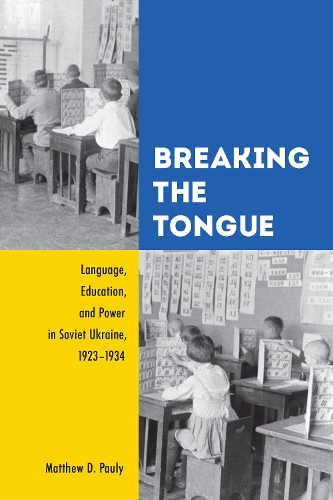
Книга Breaking the Tongue: Language, Education, and Power in Soviet Ukraine, 1923-1934
"Breaking the Tongue is ground-breaking in its focus on the link between education, politics and Ukrainization. This book will be read with great interest by scholars in the fields of Soviet studies, Ukrainian and Russian history, Ukrainization, nationalism, and post-revolutionary cultural-education policy." -- Myroslav Shkandrij, Department of German and Slavic Studies, University of Manitoba
In the 1920s and early 1930s, the Communist Party embraced a policy to promote national consciousness among the Soviet Union’s many national minorities as a means of Sovietizing them. In Ukraine, Ukrainian-language schooling, coupled with pedagogical innovation, was expected to serve as the lynchpin of this social transformation for the republic’s children.
The first detailed archival study of the local implications of Soviet nationalities policy, Breaking the Tongue examines the implementation of the Ukrainization of schools and children’s organizations. Matthew D. Pauly demonstrates that Ukrainization faltered because of local resistance, a lack of resources, and Communist Party anxieties about nationalism and a weakening of Soviet power – a process that culminated in mass arrests, repression, and a fundamental adjustment in policy.
"
‘Pauly’s book offers a unique and important study of the intersection of school reform and nationalities policy.’
" - Historical Studies in Education"
‘Breaking the Tongue will be a very useful volume. It is scholarly, well-researched, and highly contextual study with ample sources, including good use of original Ukrainian documents.’
" - Canadian Journal of History"
‘This clearly written and effectively researched monograph focuses on educational policy as it was implemented, challenged, and ultimately practiced in the school houses of Ukraine…. Breaking the Tongue adds an important dimension to Soviet childhood studies.’
" - Slavic Review"
‘Pauly’s highly detailed and highly nuanced monograph is an outstanding contribution to our understanding of how Ukrainization evolved and how the multinational USSR dealt with social contradictions and unintended consequences in its early period.’
" - The Russian Review"
‘This is an important monograph based on meticulous archival research and a solid theoretical foundation, Pauly’s study will be of interest to historians of Ukraine and the Soviet Union, as well as anyone investigating the relationship between education and national identity.’
" - Revolutionary Russia"
‘It is a very important step forward in our general understanding of Ukrainization and Soviet nationality politics in the 1920s. It should be read by all those who study Soviet policies of the 1920s and Russian-Ukrainian relations.’
" - American Historical Review"
‘Pauly’s new book brings to light extensive archival material and offers a unique insight into the workings of the Soviet nationalities policy on the micro-level of the school…. A remarkably timely and relevant contribution to the field.’
" - Slavonic & East European Review"
‘Packed with biographies of little-known victims of the 1930s purges, this book gives valuable insight into a pivotal aspect of Soviet history that deserves similar attention in other regions of the former USSR… Highly recommended.’
" - Choice Magazine"
"Pauly’s record on the Ukrainisation of the school system in the Ukrainian SSR provides an insight not only into the specificities of this particular case but more broadly into how education and power intersect to produce ‘desirable’ political and social outcomes. [...] Pauly has put together a rich documentary record that speaks to various disciplines. Apart from historical and educational research, it is relevant to the social sciences in general and nationalism and (post-)communist studies in particular."
" - Europe-Asia Studies"
"Matthew Pauly’s book explores one of the most fascinating episodes of Ukrainian history in general and education in particular: an attempt by the Soviet authorities in the 1920s to introduce Ukrainian as the main language of instruction in schools and other educational establishments."
" - European Education"
"The question of language surfaces repeatedly in analysis of Ukraine. Simplified binaries such as the ‘Russian-speaking East’ and the ‘Ukrainian-speaking West’ imply that language equals nationality. Matthew Pauly’s Breaking the Tongue exposes the ineffectiveness of this equivalency in explaining the complicated and multiple senses of belonging in today’s post-Soviet Ukraine."
" - History of Education Quarterly"
"American historian Matthew D. Pauly’s book Breaking the Tongue is a multi-layered work that not only reconstructs a complicated period in the history of the Soviet Union, but also brings to light many overreaching and perpetual global issues that deal with education, political power and nationalism."
" - Paedagogica Historica"
"In this painstakingly researched book Matthew D. Pauly does an excellent job at filling in this blank spot in Ukrainian and Soviet history. Along the way he provides a number of valuable insights into the ambivalent nature of Soviet nation building and the survival of hybrid identities from the czarist period, such as Russian-speaking Ukrainians."
" - University of Toronto Quarterly