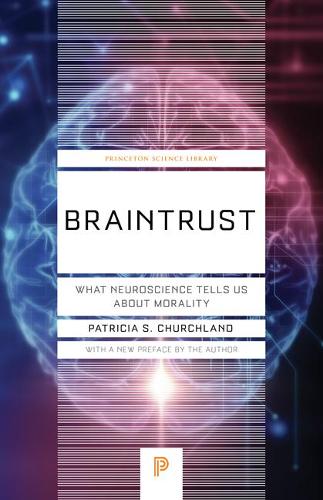
Книга Braintrust: What Neuroscience Tells Us about Morality
A provocative new account of how morality evolved
What is morality? Where does it come from? And why do most of us heed its call most of the time? In Braintrust, neurophilosophy pioneer Patricia Churchland argues that morality originates in the biology of the brain. She describes the "neurobiological platform of bonding" that, modified by evolutionary pressures and cultural values, has led to human styles of moral behavior. The result is a provocative genealogy of morals that asks us to reevaluate the priority given to religion, absolute rules, and pure reason in accounting for the basis of morality.
Moral values, Churchland argues, are rooted in a behavior common to all mammals—the caring for offspring. The evolved structure, processes, and chemistry of the brain incline humans to strive not only for self-preservation but for the well-being of allied selves—first offspring, then mates, kin, and so on, in wider and wider "caring" circles. Separation and exclusion cause pain, and the company of loved ones causes pleasure; responding to feelings of social pain and pleasure, brains adjust their circuitry to local customs. In this way, caring is apportioned, conscience molded, and moral intuitions instilled. A key part of the story is oxytocin, an ancient body-and-brain molecule that, by decreasing the stress response, allows humans to develop the trust in one another necessary for the development of close-knit ties, social institutions, and morality.
A major new account of what really makes us moral, Braintrust challenges us to reconsider the origins of some of our most cherished values.
"This empirically based, superbly argued text by Churchland undoubtedly will ruffle many feathers. . . . Churchland eloquently defends the naturalization of morality, inviting readers to reconsider such normatively significant notions as empathy, caring, and trust in light of new understandings of the role of oxytocin and other hormones, possibilities inherent in mirror neurons, and distinctions between various forms of psychopathy and normal behaviors. Additionally, she tackles head-on deeply rooted philosophical challenges that are motivated by the famous is-ought fallacy or embedded in more traditional moral theories such as consequentialism or deontology. Though Churchland's approach is cautious, it is convincing." - Choice