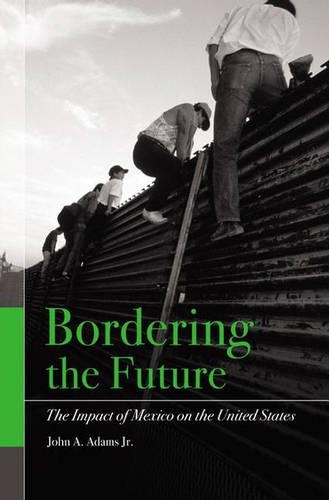
Книга Bordering the Future: The Impact of Mexico on the United States
"John Adams has performed a valuable function for anyone interested in knowing more about Mexico's economy. He has used his vast experience on the border and as a promoter of mutually beneficial trade to make clear and understandable a complicated but important topic." -- Jeffrey Davidow, U.S. Ambassador to Mexico, 1998-2002, Author of The US and Mexico: The Bear and the Porcupine "Dr. Adams' insights into the evolving U.S.-Mexico relationship couldn't be more timely. As the two countries seek to shape their shared future, at a time of heightened border security, Adams' assessment of the forces propelling U.S.-Mexico economic interdependence provides the context in which informed research and policy debates can take place." -- J. Michael Patrick, Regents Professor, Department of Accounting, Economics, and Finance, Director, Texas Center for Border Economic and Enterprise Development, Texas A&M International University "From his many years on the border in Laredo, Texas, John Adams Jr. has come to know Mexico like his own backyard. In this timely book, he explains the opportunities and challenges of America's relationship with our Mexican neighbors at a time when a growing number of politicians in Washington want to literally build walls between us." -- Daniel Grsiwold, Director, Center for Trade Policy Studies, Cato Institute
The differences between the United States and Mexico may be immense, but their links—economic, political, and social—are profound, and growing stronger. In this incisive narrative, John Adams argues that Mexico, with which the United States shares a 1,951 mile border, is no sideshow but a pivotal component of American economic health and regional security. The primary theme that runs throughout this book is that Mexico has historically had, and will continue to e Drawing from the most current economic and demographic data and business examples, Adams demonstrates the depth and breadth of U.S.-Mexican relations, and their implications for American business and policymaking. In the process, he dispels popular myths about Mexico as an economic backwater or political distraction. The result is an authoritative and colorful account of our complex relationship with our neighbor to the south, and its broader implications for global growth and political stability.
The border between the United States and Mexico runs for 1,951 miles. The differences between the two nations may be immense, but their links—economic, political, and social—are profound, and growing stronger. In this incisive narrative, John Adams argues that Mexico is no sideshow, but a pivotal component of American economic health and regional security. The primary theme that runs throughout the book is that Mexico—its domestic growth and industrial capacity, population pressures, energy needs, political dynamics, and strategic location—has historically had, and will continue to have, a tremendous impact on the United States.
Drawing from the most current economic and demographic data and business examples, Adams demonstrates the depth and breadth of U.S.-Mexican relations and their implications for American business and policymaking. A unique aspect of the book is his analysis of the competition between Mexico and China for American resources for investment, trade, and economic development. Adams also dispels popular myths about Mexico as an economic backwater or political distraction. The result is an authoritative and colorful account of our complex relationship with our neighbor to the south—and its broader implications for global economic growth and political stability.