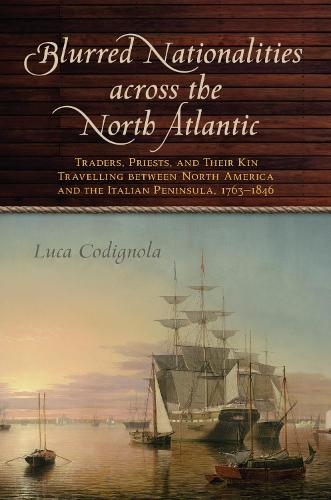
Long before the mid-nineteenth century, thousands of people were frequently moving between North America – specifically, the United States and British North America – and Leghorn, Genoa, Naples, Rome, Sicily, Piedmont, Lombardy, Venice, and Trieste. Predominantly traders, sailors, transient workers, Catholic priests, and seminarians, this group relied on the exchange of goods across the Atlantic to solidify transatlantic relations; during this period, stories about the New World passed between travellers through word of mouth and letter writing.
Blurred Nationalities across the North Atlantic challenges the idea that national origin – for instance, Italianness – constitutes the only significant feature of a group’s identity, revealing instead the multifaceted personalities of the people involved in these exchanges.
"
"Codignola’s case studies are compelling, and the enormous extent of the research that went into his work is testified by the 160 pages of endnotes […] There is no doubt that his work is an important contribution to the study of Italian-North American relations and more generally to the study of transnational links across the Atlantic and into the Mediterranean between the mid-eighteenth and the mid-nineteenth centuries."
" -
American Historical Review