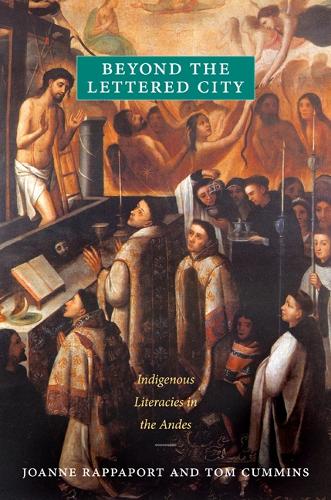
Книга Beyond the Lettered City: Indigenous Literacies in the Andes
This book extends the conception of literacy beyond the written word to incorporate the visual. Focusing on the period of colonization in the Andean region the authors argue that the European cultural literacy that they imposed on the indigenous population was not just a tool for oppression and control but was used by the local people as a means to assert their own cultural identity
In Beyond the Lettered City, the anthropologist Joanne Rappaport and the art historian Tom Cummins examine the colonial imposition of alphabetic and visual literacy on indigenous groups in the northern Andes. They consider how the Andean peoples received, maintained, and subverted the conventions of Spanish literacy, often combining them with their own traditions. Indigenous Andean communities neither used narrative pictorial representation nor had alphabetic or hieroglyphic literacy before the arrival of the Spaniards. To absorb the conventions of Spanish literacy, they had to engage with European symbolic systems. Doing so altered their worldviews and everyday lives, making alphabetic and visual literacy prime tools of colonial domination. Rappaport and Cummins advocate a broad understanding of literacy, including not only reading and writing, but also interpretations of the spoken word, paintings, wax seals, gestures, and urban design. By analyzing secular and religious notarial manuals and dictionaries, urban architecture, religious images, catechisms and sermons, and the vast corpus of administrative documents produced by the colonial authorities and indigenous scribes, they expand Ángel Rama’s concept of the lettered city to encompass many of those who previously would have been considered the least literate.
"“Beyond the Lettered City reveals the complexity of Andean society, the challenges of new administrative procedures, and the interaction between Spaniards and the indigenous peoples who were able to become their own advocates.”" - Hispanic American Historical Review
"“In this interesting contribution to the study of colonial expression, the authors take a novel approach to analysing culture by combining anthropology with art history. The result is an original perspective on how colonial domination at the level of meaning took place….The authors provide striking and dramatic examples of how the natives engaged with and internalised this new visual culture.”" - Latin American Review of Books
"“The collection of such a vast set of visual images is alone a momentous task. The breadth of scholarship is impressive. Text and image blend effortlessly in the fine narrative. Many forms of literacies are explored. I am certain that others, as they read and reread sections, will be stimulated as I am to explore further.”" - Ethnohistory
"“Beyond the Lettered City is an exceptionally important, path-breaking contribution to the study of the transformations of society and culture in the northern and central Andes from the time of the Iberian invasion until the early 18th century.” " - ReVista
"“A richly researched work of mature, broad-reaching scholarship, Beyond the Lettered City is at the same time an experiment in innovative historiography. It is likely to intrigue art-oriented and letter-oriented readers for a long time to come.”" - Journal of Latin American and Caribbean Anthropology
"“Beyond the Lettered City represents an important, innovative, and interdisciplinary study that should be mandatory reading for anyone seriously interested in the art, history, and culture of colonial Spanish America. More broadly, it deserves an audience among scholars of other colonial and postcolonial societies where the issues of artistic cultural adaptation and transfer also are topics of major concern.”" - Catholic Historical Review
"“This book is a seminal text, an important addition to scholarship not only on the history of the Andes and colonial Latin America but on the semiotic, material, and meaning-making dimensions of colonial encounters generally. The book’s argument for a radically expanded notion of literacy is made with riveting force and precision. Received ideas about literacy and the domination of the written word have rarely been attacked through such a richly evocative analytic framework."" - Journal of Anthropological Research
"Beyond the Lettered City is full of highly original arguments and discoveries, and should be read by anyone with an interest in colonial Latin American art and writing." - Anthropos