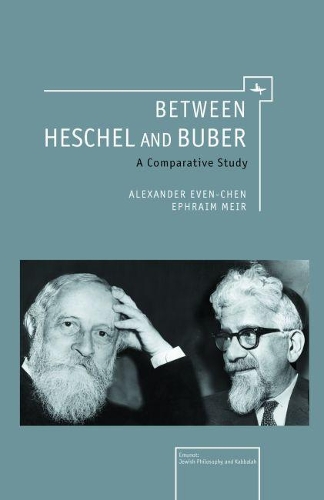
Abraham Joshua Heschel and Martin Buber were giant thinkers of the twentieth century who made significant contributions to the understanding of religious consciousness and of Judaism. They wrote on various subjects, such as the Bible, the commandments, Hasidism, Zionism and Christianity, and had much in common, though they also differed on substantial points. Of special note is the intense and fruitful interaction that took place between them. Until now, scholars have not undertaken a comparative analysis of Buber and Heschel as eminent contemporary interpreters of the Jewish tradition. In this volume, Meir and Even-Chen have taken upon themselves the challenge of monitoring their agreements and disputes.
"Between them, articles relating to Martin Buber and Abraham Joshua Heschel account for over nine hundred entries in the Jewish National Library’s Index of Articles on Jewish Studies. Add to this the steady stream of books concerning either Buber or Heschel, and the sheer bulk of the bibliography is even more daunting. Comparisons between the two thinkers, however, are rare. None of the previous attempts to set these two figures alongside each other in search of affinities and contrasts compares in scope and depth to the volume under review. By undertaking a well-structured and thoughtful comparison of the men they describe as ‘giant and committed thinkers of the twentieth century,’ Alexander Even-Chen and Ephraim Meir have achieved a significant feat. Rather than being one more entry in a crowded field, Between Heschel and Buber deserves a special place within a rapidly burgeoning literature. . . . Without doubt, [the authors] have moved the discourse concerning the interface between Heschel and Buber to a new level of sophistication and depth." - H-Judaic, April, 2013