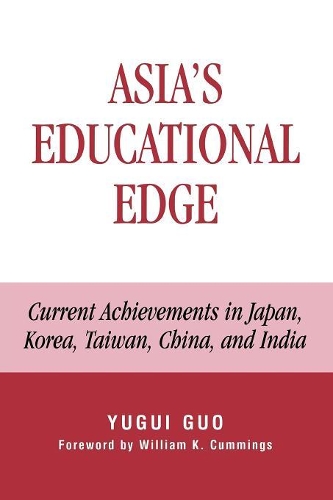
Книга Asia's Educational Edge: Current Achievements in Japan, Korea, Taiwan, China, and India
The United States in the past half-century has consistently led the world in the strength of its economy and in scientific research and development. Now, this position at the forefront of industry and innovation is threatened. Asia's Educational Edge warns that the United States relies heavily on the talent of foreign-born scientists and engineers_skilled workers who face increasing, and increasingly favorable, options for employment elsewhere. East Asia's and India's emerging economies are expanding their own higher education capacity in the sciences and their own research and development infrastructure. Accordingly, the United States faces great and growing competition in attracting talented students and professionals from the international community. In this carefully researched volume, Yugui Guo asks: Can the U.S. education system succeed in training enough high-quality students in the sciences to meet the ever-growing need? Asia's Educational Edge is essential reading for industrial and research leaders, policy makers, educators, and scholars of international and comparative education.
"Asia's Educational Edge: Current Achievements in Japan, Korea, Taiwan, China, and India was undertaken both to provide a comparitive analysis of the educational systems— including K-12 education, higher education, and international education— of these five economies and to ask whether the United States will be prepared to train its own students in science and technology fields as more and more Asians seek tertiary education, terminal degrees, and ultimately, careers in Asia.... Armed with an impressive arsenal of statistics, presented intertextually as well as graphically, Guo predicts that, as opportunities increase in Asia, a smalle proportion of Asians will train for advanced degrees in the STEM( (science, technology, engineering, and mathematics) fields in the United States.... Guo's book should provide a useful resource to scholars of Asia or international education." - Southeast Review of Asian Studies, Volume 29 (2007)