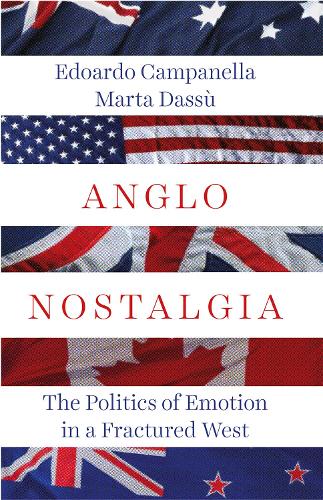
Nostalgia has become a major force in global politics. While Donald Trump hopes to ‘make America great again’, Xi Jinping calls for a ‘great rejuvenation of the Chinese people’, and a majority of Russians still mourn the Soviet Union. But it is Brexit, with its idealisation of a bygone era of full sovereignty, that epitomises nostalgic nationalism in its purest form.
Despite its romantic flavour, nostalgia is a malaise—a combination of paranoia and melancholy that idealises the past, while denigrating the present. This epidemic of mythicising national history is shaping politics in risky ways, fuelled by ageing populations, shifts in the global order, and technological disruption. When deployed in the political debate, collective nostalgia is used as an emotional weapon, capable of mobilising a nation towards illusory goals.
Drawing on psychology, political science, history and popular culture, Anglo Nostalgia analyses the rapid spread of this global phenomenon, before focusing on Brexit as a case study. With the detachment of informed outsiders, Campanella and Dassù expose nostalgia’s great danger: the oversimplification of reality, leading to unprecedented political miscalculations and rising geopolitical tensions.
"'[Trump's] mindset is well described in 'Anglo Nostalgia' by Edoardo Campanella and Marta Dassù. Start with an idealised view of the past, stir in the paranoia beloved of populists everywhere and, hey presto, you have the nostalgic nationalism that is his foreign policy.'" - Financial Times