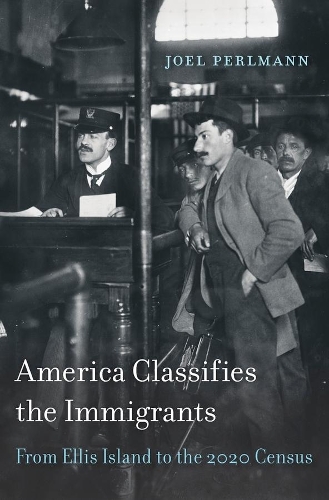
Книга America Classifies the Immigrants: From Ellis Island to the 2020 Census
When more than twenty million immigrants arrived in the United States between 1880 and 1920, the government attempted to classify them according to prevailing ideas about race and nationality. But this proved hard to do. Ideas about racial or national difference were slippery, contested, and yet consequential—were “Hebrews” a “race,” a “religion,” or a “people”? As Joel Perlmann shows, a self-appointed pair of officials created the government’s 1897 List of Races and Peoples, which shaped exclusionary immigration laws, the wording of the U.S. Census, and federal studies that informed social policy. Its categories served to maintain old divisions and establish new ones.
Across the five decades ending in the 1920s, American immigration policy built increasingly upon the belief that some groups of immigrants were desirable, others not. Perlmann traces how the debates over this policy institutionalized race distinctions—between whites and nonwhites, but also among whites—in immigration laws that lasted four decades.
Despite a gradual shift among social scientists from “race” to “ethnic group” after the 1920s, the diffusion of this key concept among government officials and the public remained limited until the end of the 1960s. Taking up dramatic changes to racial and ethnic classification since then, America Classifies the Immigrants concentrates on three crucial reforms to the American Census: the introduction of Hispanic origin and ancestry (1980), the recognition of mixed racial origins (2000), and a rethinking of the connections between race and ethnic group (proposed for 2020).
"A readable and sophisticated discussion of the context of social science thinking about race, ethnicity, and national origins for official statistics on immigrant origins…A panoramic survey. It is a deeply researched and captivating book…Provides rich insights into the ways in which immigrants have been classified in America." - Population and Development Review
"We can learn a lot from [this] book about how conflicting agendas, behemoth ambitions, and unwarranted optimism produced classification schemes that negatively affected the lives of millions of Americans and would-be immigrants. We might do well to pair that knowledge with a stronger sense of humility than our forbearers held as we move forward in our own research." - Journal of Urban History
"A cogent and compelling analysis of the muddle of meanings embedded in the terms race, peoples, national origins, and mother tongue as used by scholars, politicians, and administrators in the Bureau of Immigration and the U.S. Census Bureau." - Forward
"An insightful examination of how the US adopted and revised categories of immigrants over almost 150 years…Well researched and lucidly presented." - Choice
"Perlmann provides us with a brilliant historical account of how Southern and Eastern Europeans, particularly Jews, were thought about, classified, and rendered legible by the state." - American Journal of Sociology
"A work of deep erudition, impressive for its temporal scope but no less because breadth does not come at the expense of a fine-grained account of governmental classificatory practices. The key episodes selected by the author allow us to probe what it means that immigration policy was propelled by official acts of discrimination…Meticulously written, clear, and provocative—a book not to be missed." - International Migration Review
"A well-written, compelling analysis of how the U.S. statistical system grappled with the increasing heterogeneity of the origins of immigrants and their U.S.-born descendants from the turn of the 20th century to the present. It is a story that tells us as much (or more) about America—including its political decisions, the federal bureaucracy, attitudes toward race, and the social sciences over this period—as it does about the immigrants themselves." - Studies in Contemporary Jewry