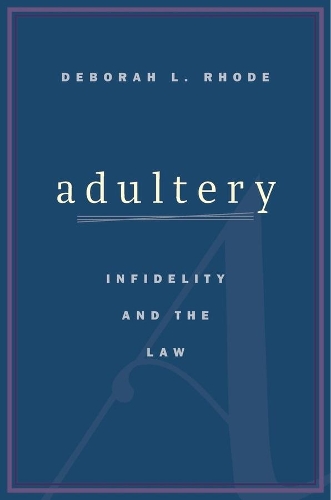
Книга Adultery: Infidelity and the Law
At a time when legal and social prohibitions on sexual relationships are declining, Americans are still nearly unanimous in their condemnation of adultery. Over 90 percent disapprove of cheating on a spouse. In her comprehensive account of the legal and social consequences of infidelity, Deborah Rhode explores why. She exposes the harms that criminalizing adultery inflicts, and she makes a compelling case for repealing adultery laws and prohibitions on polygamy.
In the twenty-two states where adultery is technically illegal although widely practiced, it can lead to civil lawsuits, job termination, and loss of child custody. It is routinely used to threaten and tarnish public officials and undermine military careers. And running through the history of anti-adultery legislation is a double standard that has repeatedly punished women more severely than men. An “unwritten law” allowing a man to avoid conviction for killing his wife’s lover remained common well into the twentieth century. Murder under these circumstances was considered an act of understandable passion.
Adultery has been called the most creative of sins, and novelists and popular media have lavished attention on sexual infidelity. As a focus of serious study, however, adultery has received short shrift. Rhode combines a comprehensive account of the legal and social consequences of adultery with a forceful argument for halting the state’s policing of fidelity.
"Adultery remains illegal in 21 states. Rhode, though no fan of adultery, argues that it should not be prohibited by law, because such laws infringe on our constitutionally protected right to privacy—and have proved woefully ineffective, in any event, at protecting the institution of marriage." - New York Times Book Review
"Rhode’s scope is historically and geographically massive, from ancient Babylonia to Hawthorne-era New England to Eliot Spitzer, making for a fascinating comparative study." - Maclean’s
"Makes for quite an education, even for someone like me who (professionally, I must stress, as a divorce lawyer) encounters adultery on a regular basis. In her comprehensive and colorful account of the legal and social consequences of infidelity, Rhode describes how the law governing adultery has an unbecoming history, marked by intrusive inquiries, inconsistent application, and racial, class and gender bias. She explores why, at a time when sexual attitudes have grown more liberal, Americans remain largely unanimous in their disapproval of adultery…A thoroughly engaging and entertaining read." - Law Society Gazette
"Rhode succeeds in providing an unparalleled sociolegal take on the issues of infidelity and adultery with a focus on how the continued patrolling and protection of sexual relationships is not only no longer necessary, but also that it holds inherent discrimination—and is thus archaic law." - Library Journal
"For those fascinated by the history of this common but largely intolerable act, the volume is thorough and contributes to an argument that no doubt will continue for some time to come." - PopMatters
"[Rhode] demonstrates that while the majority of Americans consider extramarital affairs morally wrong, most also believe that they should not be criminalized." - Times Literary Supplement