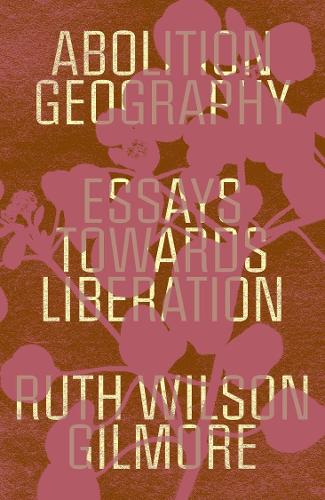
Книга Abolition Geography: Essays Towards Liberation
First collection of writings from one of the foremost contemporary critical thinkers on racism, geography and incarceration.
Gathering together Ruth Wilson Gilmore's work from over three decades, Abolition Geography presents her singular contribution to the politics of abolition as theorist, researcher, and organizer, offering scholars and activists ways of seeing and doing to help navigate our turbulent present.
Abolition Geography moves us away from explanations of mass incarceration and racist violence focused on uninterrupted histories of prejudice or the dull compulsion of neoliberal economics. Instead, Gilmore offers a geographical grasp of how contemporary racial capitalism operates through an "anti-state state" that answers crises with the organized abandonment of people and environments deemed surplus to requirement. Gilmore escapes one-dimensional conceptions of what liberation demands, who demands liberation, or what indeed is to be abolished. Drawing on the lessons of grassroots organizing and internationalist imaginaries, Abolition Geography undoes the identification of abolition with mere decarceration, and reminds us that freedom is not a mere principle but a place.
Edited with an introduction by Brenna Bhandar and Alberto Toscano.
"Scholars like Ruthie Gilmore, filmmakers like Ava Duvernay, and formerly incarcerated people like Glenn Martin have all done work to expose the many injustices of the industry of our prison system." - Time
"An essential collection of writings from one of the most important thinkers on abolition, geography and racism of our time." - Ms.Magazine
"Abolition Geography is the first collection of writing by this major thinker, activist, and writer in the fields of racism, geography, and incarceration. The book includes essays, articles, and interviews from the last two decades, covering topics such as the origin of mass incarceration and racial violence and the concept of the 'anti-state state'." - Autostraddle
"Anyone with an interest in the critical theory of mass incarceration and social justice can't miss this first-ever compendium of writing by one of the most brilliant and radical minds in the field. [An] impactful guidebook for a whole new generation looking to join the movement." - The Chicago Review of Books
"For over three decades, Gilmore's work has been crucial to the study of policing and prison abolition...Her newest anthology, Abolition Geography: Essays Towards Liberation, includes essays on policing, capitalism and organizing [that] are more critical than ever two years after the largest street mobilization in decades. Expertly assembled by scholars Brenna Bhandar and Alberto Toscano, the anthology reproduces Gilmore's essays chronologically from 1991 to 2018. The only way to escape the cycles of police violence, protest and retrenchment will be to collectively build popular, abolitionist frameworks for relating to each other. Gilmore's work helps us move toward that goal." - AJ+
"A geographer by training, Gilmore has a sweeping understanding of prisons and policing, one that approaches the issue at scale. If you haven't read her yet, it's a good year to start." - Teen Vogue
"A scathing exploration of global systems of oppression through a lens of geography, in which [Gilmore] asserts that freedom and liberation are a physical, tangible place - they're material conditions, not platitudes and niceties from ultra-rich politicians." - Jezebel
"Introduced by a stimulating essay by Brenna Bhandar and Alberto Toscano, [Abolition Geography] ranges from theoretical chapters originally published in academic journals to public speeches and interviews conducted with other scholars. This anthology format allows the reader to see how Gilmore introduces, experiments with and then develops ideas in real time, taking us from the 1992 Los Angeles riots to the 2021 neo-fascist attack on the US Capitol building." - New Frame
"Gilmore is clear as a bell: potent and factual on injustice, filled with sharp intelligence and even wit, but also somehow continuously surprising and emotional. With every page, Gilmore forces us to think of race, class, prisons, and the world in entirely new ways." - NPR
"Gilmore's work is enlightening and informative, a must-read for scholars and activists seeking a complex and interdisciplinary deep dive to effectively drive systemic change...Anyone committed to prison reform and social justice has much to learn from Gilmore's insights about the cognitive work and tactical organizing required to imagine and build an abolitionist future." - Seattle Book Review
"Gilmore's prose is descriptive and direct; it describes a society whose economy has failed too many of its members and whose only solution is to create a police state." - Counterpunch
"More than explaining or urging any single scalar change in social life, the purpose of Abolition Geography is to develop the ability of its readers to study the transformations of racial capitalism, figure out what to do about them, and follow through with enough patience to withstand the enormity of the task and enough urgency to get it done...Abolition Geography is written to be used." - Dissent
"As Gilmore always reminds us, theory is a guide for action. This volume is a call to get on with the practice of getting free together." - Smithsonian Magazine, Best Books of 2022
"Notable book, 2022" - Seminary Co-op
"[Abolition Geography] is only the latest generous and supportive gift from Gilmore to liberation-minded abolitionist movements. This gift seems to be written as a call, an invitation to act and do...Abolition Geography contains fire, grit, and hope as well." - The Avery Review
"Gilmore highlights the role of social justice unionism and the ideological work of recognizing the continuum of exploitation and oppression and imperialism. Understanding the prison and policing system enables us to see how racist oppression and worker exploitation function to try to resolve the crisis of capitalism. Our people, our class, and our communities are the victims." - People's World
"Abolition Geography is valuable to anyone committed to understanding and transforming the geographies of
injustice that shape our world. I look forward to eagerly sharing the book with a range of peers and students." - Canadian Geographies