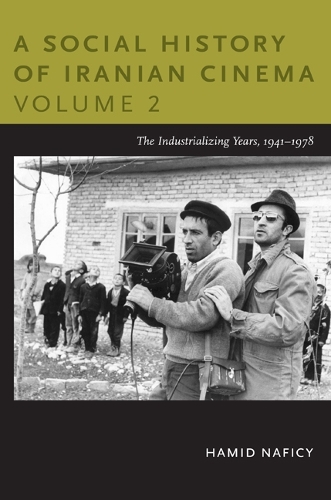
Книга A Social History of Iranian Cinema, Volume 2: The Industrializing Years, 1941–1978
The second of 4 volumes in the definitive history of Iranian film
Hamid Naficy is one of the world’s leading authorities on Iranian film, and A Social History of Iranian Cinema is his magnum opus. Covering the late nineteenth century to the early twenty-first and addressing documentaries, popular genres, and art films, it explains Iran’s peculiar cinematic production modes, as well as the role of cinema and media in shaping modernity and a modern national identity in Iran. This comprehensive social history unfolds across four volumes, each of which can be appreciated on its own.
Volume 2 spans the period of Mohammad Reza Shah’s rule, from 1941 until 1978. During this time Iranian cinema flourished and became industrialized, at its height producing more than ninety films each year. The state was instrumental in building the infrastructures of the cinema and television industries, and it instituted a vast apparatus of censorship and patronage. During the Second World War the Allied powers competed to control the movies shown in Iran. In the following decades, two distinct indigenous cinemas emerged. The more popular, traditional, and commercial filmfarsi movies included tough-guy films and the “stewpot” genre of melodrama, with plots reflecting the rapid changes in Iranian society. The new-wave cinema was a smaller but more influential cinema of dissent, made mostly by foreign-trained filmmakers and modernist writers opposed to the regime. Ironically, the state both funded and censored much of the new-wave cinema, which grew bolder in its criticism as state authoritarianism consolidated. A vital documentary cinema also developed in the prerevolutionary era.
A Social History of Iranian Cinema
Volume 1: The Artisanal Era, 1897–1941
Volume 2: The Industrializing Years, 1941–1978
Volume 3: The Islamicate Period, 1978–1984
Volume 4: The Globalizing Era, 1984–2010
"“These volumes reveal the unspoken side of Iranian culture, society and history within the context of film and cinema. This marvellously detailed account of Iranian cinema is a must-read for anyone who is interested in understanding Iran in the past and present, a true story of a long-term, ongoing revolution in Iranian culture, society and film.”" - Media International Australia
"“While the first two volumes that I have had the pleasure to review here are indeed comprehensive, covering great depth and breadth, I find Naficy to be a very open, collegial scholar whose work certainly does not close down the field. Rather, at times, Naficy openly signals that more research is still to be conducted into certain areas ensuring that the field of Iranian cinema studies may live on with vital and vibrant energy. Graduate students in particular should take heed of these openings in the text, for therein lie great possibilities for future, compelling and original scholarship in the field.... I can only conclude my review by emphasizing what I said in my opening comment: this is rich, compelling, and complex scholarship at its very finest. Thanks Hamid!”
" - Senses of Cinema
"“The four volumes of A Social History of Iranian Cinema constitute a landmark achievement. . . . For students of Iranian cinema, I can think of no better place to begin than these four volumes. The sheer expansiveness of Naficy’s project is a testimony to the untold narratives, theoretical paradigms, and concepts waiting to be found in the ongoing history of Iranian cinema."" - International Journal of Middle East Studies