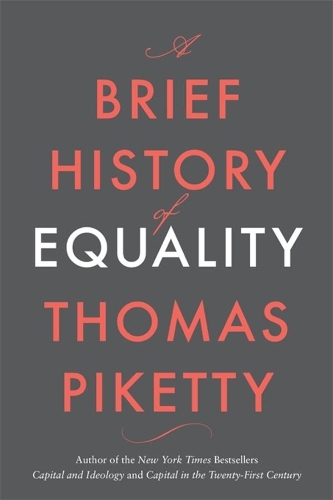
Книга A Brief History of Equality
A New York Times Book Review Editors’ Choice
A Public Books Best Book of the Year
“An opportunity for readers to see Piketty bring his larger argument about the origins of inequality and his program for fighting it into high relief.”
—Nicholas Lemann, New York Times
The world’s leading economist of inequality presents a short but sweeping and surprisingly optimistic history of human progress toward equality despite crises, disasters, and backsliding. A perfect introduction to the ideas developed in his monumental earlier books.
It’s easy to be pessimistic about inequality. We know it has increased dramatically in many parts of the world over the past two generations. No one has done more to reveal the problem than Thomas Piketty. Now, in this surprising and powerful new work, Piketty reminds us that the grand sweep of history gives us reasons to be optimistic. Over the centuries, he shows, we have been moving toward greater equality.
Piketty guides us with elegance and concision through the great movements that have made the modern world for better and worse: the growth of capitalism, revolutions, imperialism, slavery, wars, and the building of the welfare state. It’s a history of violence and social struggle, punctuated by regression and disaster. But through it all, Piketty shows, human societies have moved fitfully toward a more just distribution of income and assets, a reduction of racial and gender inequalities, and greater access to health care, education, and the rights of citizenship. Our rough march forward is political and ideological, an endless fight against injustice. To keep moving, Piketty argues, we need to learn and commit to what works, to institutional, legal, social, fiscal, and educational systems that can make equality a lasting reality. At the same time, we need to resist historical amnesia and the temptations of cultural separatism and intellectual compartmentalization. At stake is the quality of life for billions of people. We know we can do better, Piketty concludes. The past shows us how. The future is up to us.
"A sustained argument for why we should be optimistic about human progress…An engaged and clearheaded socialist thinker, Piketty sets forth…one of the most comprehensive and comprehensible social democratic programs available anywhere…He has laid out a plan that is smart, thoughtful, and motivated by admirable political convictions." - Washington Post
"An opportunity for readers to see Piketty bring his larger argument about the origins of inequality and his program for fighting it into high relief." - New York Times
"A Brief History of Equality is a route into Piketty’s arguments in his earlier books, with their luxuriantly extensive data and historical detail. Anybody who has not been able to face those tomes…should read this one." - Financial Times
"Peak Piketty…He possesses the rarest of abilities to analyze staggering quantities of information and offer original insights into the structures that underpin our economies…At a time when the concept of objective truth is under assault and when the nuance of argument can be drowned out by the shouting of slogans, there is something glorious about the scale of the work of Thomas Piketty. His arguments are vast in their detail, ever ambitious and always hopeful. This elegant and (by his standards) short book will allow any reader to understand the glory." - Irish Times
"An analysis that might just provide a fresh opportunity for social hope…Piketty has undeniably identified clues about how to achieve a more egalitarian world." - The Lancet
"An activist’s history, part reckoning with the past and part manifesto for the future, designed to bolster the courage of those who would continue the forward march. It is an admirable undertaking…Piketty mounts an impassioned plea for a renewed and retooled commitment to equality in its various forms, laying out an ambitious blueprint for a new kind of democratic, self-managing and decentralized socialism, not least as a counter to the authoritarian, state-socialist model of China." - Literary Review
"Piketty is now attempting to revive an egalitarian political project that he traces all the way back to the Enlightenment, but which has stalled since 1980. In A Brief History of Equality he lays out a program of democratic socialist reforms—to taxation, property rights, corporate governance, international regulation and much else—that would invert recent trends." - London Review of Books
"Tidier and more lucid…Piketty is guardedly optimistic about the prospects for future social progress." - New Republic
"Piketty…avoid[s] the twin seductions of triumphalism and hopelessness. He treats the concept of equality more expansively here, including not only income and property but also gender and race. By moving the focus from inequality to equality, he suggests that what’s needed isn’t only the harsh light of critique but also the remedy of repair." - New York Times
"[Piketty] argues that we’re on a trajectory of greater, not less, equality and lays out his prescriptions for remedying our current corrosive wealth disparities." - New York Times Magazine
"A nice distillation of the ‘rockstar’ economist’s ideas and a good entry point for the uninitiated…[Piketty] points out that an unequal concentration of wealth is bad for growth and corrosive to democracy, precisely because it limits social mobility and prevents people from accessing key institutions…If the politics of Europe and America during the last decade have taught us anything, it is that the failure to address inequality is highly corrosive to the social contract. It fosters distrust and resentment, and makes people vulnerable to demagogy, populism, xenophobia, and reactionary politics of all kinds." - Quillette
"Surprisingly optimistic…Building on his previous works and drawing on the sweeping historical record, Piketty brings his larger argument about the origins of inequality and the political, social, and institutional contexts of its evolution into sharp relief." - Finance & Development
"Thomas Piketty presents a narrative of history that is optimistic—a narrative that shows, despite numerous setbacks, over the long durée that civilization is trending towards social, economic and political equality." - Marx and Philosophy Review of Books
"Merciful in its brevity, although no less intellectually rigorous. Designed to be read by politically-minded citizens, not just economists, it distills the key concepts from Piketty’s previous three books…Piketty’s overview of 20th-century history and politics has given us a blueprint for achievable political transformation and reason to hope that progress is possible." - PopMatters
"[Piketty] constantly rethinks and seeks to address new audiences. His impact on political thinking and strategy is undoubted: there can be no denying that the increasing call for wealth taxation draws on his lead. In this spirit, this book will occupy a valuable place in his wider set of writings." - Administrative Science Quarterly
"This thought-provoking book is recommended to all readers who want to learn more about how the scourge of inequality might be dealt with and enhance the lives of all humans." - Choice
"Marked by Piketty’s trademark lucidity, impressive multidisciplinary scholarship, and provocative progressivism, this is a vital introduction to his ideas." - Publishers Weekly (starred review)