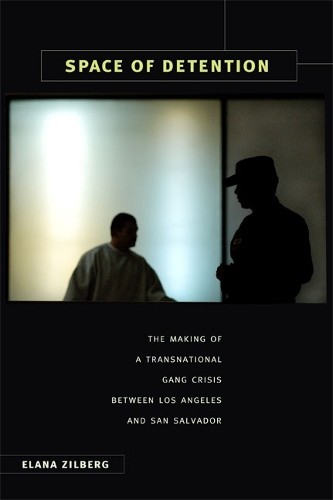
Книга Space of Detention: The Making of a Transnational Gang Crisis between Los Angeles and San Salvador
A powerful ethnographic account and spatial analysis of the "transnational gang crisis" between the United States and El Salvador
Space of Detention is a powerful ethnographic account and spatial analysis of the “transnational gang crisis” between the United States and El Salvador. Elana Zilberg seeks to understand how this phenomenon became an issue of central concern for national and regional security, and how La Mara Salvatrucha, a gang founded by Salvadoran immigrants in Los Angeles, came to symbolize the “gang crime–terrorism continuum.” She follows Salvadoran immigrants raised in Los Angeles, who identify as—or are alleged to be—gang members and who are deported back to El Salvador after their incarceration in the United States. Analyzing zero-tolerance gang-abatement strategies in both countries, Zilberg shows that these measures help to produce the very transnational violence and undocumented migration that they are intended to suppress. She argues that the contemporary fixation with Latino immigrant and Salvadoran street gangs, while in part a product of media hype, must also be understood in relation to the longer history of U.S. involvement in Central America, the processes of neoliberalism and globalization, and the intersection of immigration, criminal, and antiterrorist law. These forces combine to produce what Zilberg terms “neoliberal securityscapes.”
"“Space of Detention is an important book, one based on a fascinating and extremely impressive body of ethnographic work… [T]he book succeeds in so many ways that it merits a wide audience.”" - Journal of American Studies
"“Her analysis has much to offer geographers interested in policy transfer and harmonization…. Zilberg is able to offer a rich analysis of the intersections of Cold War militarism, transnational migration, urban restructuring, criminalization, and postconflict governmental reform in a predominantly ‘sending country’." - Environment and Planning D
"“Elana Zilberg’s book contributes to emerging scholarship making the important connections between the war on gangs, the war on drugs, and the war on terror as a continuation of US empire…. This book provides important empirical evidence to tracing the origins of post-9/11 anti-terror legislation, acts, and attitudes while providing the reader a point from which to analyze the militarization of public space today. Overall, the book is a wise choice for graduate and undergraduate courses and scholars concerned with security states and subject formation.”" - Journal of Anthropological Research
"“Zilberg endeavors to uncover realities normally obscured, and to situate anti-gang discourse and policies within a broader framework than hegemonic discourse allows.”" - Theoretical Criminology
"“Zilberg’s audiences have waited a long time for this book, and it will not disappoint. Even as it refuses to be the exposé on gangs that some may expect, it offers a powerful and original account of interlocking global processes of capitalism and criminalization.”" - Anthropological Quarterly