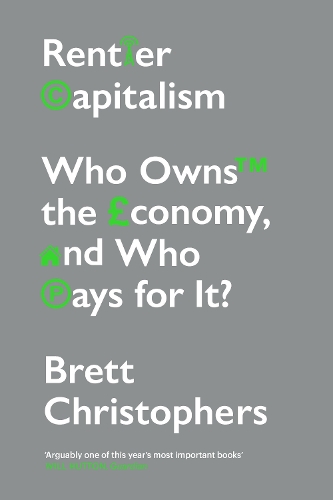
Книга Rentier Capitalism: Who Owns the Economy, and Who Pays for It?
How did Britain's economy become a bastion of inequality?
In this landmark book, the author of The New Enclosure provides a forensic examination and sweeping critique of early-twenty-first-century capitalism. Brett Christophers styles this as 'rentier capitalism', in which ownership of key types of scarce assets - such as land, intellectual property, natural resources, or digital platforms - is all-important and dominated by a few unfathomably wealthy companies and individuals: rentiers. If a small elite owns today's economy, everybody else foots the bill. Nowhere is this divergence starker, Christophers shows, than in the United Kingdom, where the prototypical ills of rentier capitalism - vast inequalities combined with entrenched economic stagnation - are on full display and have led the country inexorably to the precipice of Brexit. With profound lessons for other countries subject to rentier dominance, Christophers' examination of the UK case is indispensable to those wanting not just to understand this insidious economic phenomenon but to overcome it. Frequently invoked but never previously analysed and illuminated in all its depth and variety, rentier capitalism is here laid bare for the first time.
"In praise of The New Enclosure:
With his carefully crafted and meticulously researched study, he has made an essential contribution to our understanding of politics and government in modern Britain." - Financial Times
"In praise of The New Enclosure:
If you're someone who's interested in Britain-and I mean Britain tout court: the whole 80,823 square miles of its physical existence-then this is a book you must read." - Guardian
"In praise of The New Enclosure:
Brett Christophers's The New Enclosure towers with empirical and argumentative force. Christophers dissects the process by which 1.6 million hectares, or 8 percent of Britain, ended up in private hands since the election of Margaret Thatcher. This is a stunning work of scholarship. It speaks to the history of capitalism and social inequality, cast as the undemocratic ownership of nature." - Orion Magazine
"A seminal study" - Guardian
"An essential read for anyone thinking about what UK governments might need to do differently as the pandemic upends the economy, and people's jobs, without doubt feeding an appetite for some significant change in the philosophy of public policy." - The Enlightened Economist
"An important and urgent contribution to our understanding of modern capitalism." - openDemocracy
"A striking reminder of the way-in the UK economy, in this case-concentration of ownership has continued to increase in recent decades." - Five Books, Best Economics Books of 2020
"Arguably one of this year's most important books." - Guardian
"Rentier Capitalism is an autopsy report for a decomposing corpse. Christophers clinically dissects a corrupted body, before arriving at a probable cause of death. Of course, capitalism is still with us, but for those wanting to understand the system more, the better and sooner to end it, this book is essential reading." - Socialist Review
"It's all crackling, shimmering stuff ... you'll start seeing rentiers everywhere, hearing them in every news bulletin, or envisioning how they all interlock like a lattice of money-pipes, situated at almost every choke point in supply, and all involved in massive anti-competitive behaviour." - Irish Times
"From North Sea oil to the railways to water and electricity, this is a damning book about what successful British firms actually do - bid for privatised contracts, charge large rental fees, and sit back and let the profits come in from poor-quality, monopolised services." - Tribune
"Rentier Capitalism presents convincing evidence of the extent to which rent-seeking has become a central aspect of the British economy." - Greater Manchester Housing Action
"In his detailed and stimulating book, the political economist and economic geographer Brett Christophers offers a unifying interpretation of how rentierism works, providing a synthetic analysis of the contemporary British economy as a case study." - Baffler