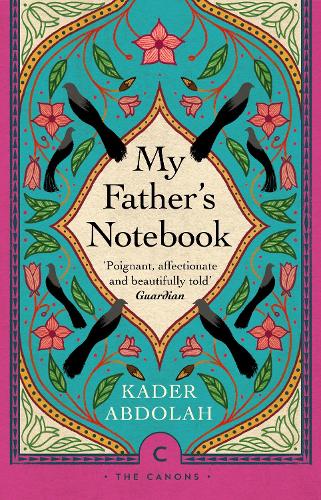
When he was a boy, Aga Akbar, the illegitimate, deaf son of a Persian nobleman, travelled with his uncle to a cave on nearby Saffron Mountain. Once there, he was to transcribe a cuneiform inscription over three thousand years old. Decades later, his son, Ishmael - a political dissident in exile - attempts to translate a notebook filled with a private language made from this ancient script . . . and in the process tells his father's story, his own, and the story of twentieth-century Iran.
My Father's Notebook is at once a masterful chronicle of a culture's troubled voyage into modernity and the heart-rending, timeless tale of a son's enduring love.
"This poignant, affectionate and beautifully told tale reflects a longing for a lost homeland" - * Guardian *
"Beautifully evoked in often touching and amusing detail . . . My Father's Notebook is an intriguing, complex and often playful novel that deserves attention" - * Scotland on Sunday *
"My Father's Notebook, a lovely novel, has the cadence of a fairy tale and the clarity of truth" - * Wall Street Journal *
"A storyteller of utmost subtlety and natural ease" - * Times Literary Supplement *
"With seamlessly interwoven quotations from Persian and Dutch literature, deft storytelling and affectionate humour, he offers the reader buoyancy as well as weight. My Father's Notebook is a gift to English readers" - * Independent *
"[A] powerful meditation . . . A moving elegy for a lost father and homeland, but also a voice raised against all forms of repression . . . My Father's Notebook reads like a detective story" - * Guardian *
"Kader Abdolah weaves Sufi myths, political intrigue and biography into a charming meditation on the relationship between father and son . . . a moving account of one man's life that serves as a fascinating reflection on conflicts between religion and politics, homeland and exile, the past and the present" - * The Skinny *