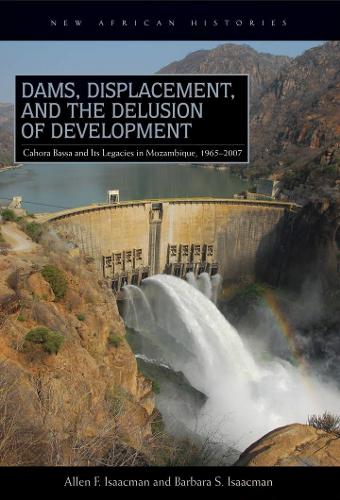
Книга Dams, Displacement, and the Delusion of Development: Cahora Bassa and Its Legacies in Mozambique, 1965–2007
This in-depth study of the Zambezi River Valley examines the dominant developmentalist narrative that has surrounded the Cahora Bassa Dam, chronicles the continual violence that has accompanied its existence, and gives voice to previously unheard narratives of forced labor, displacement, and historical and contemporary life in the dam’s shadow.
Cahora Bassa Dam on the Zambezi River, built in the early 1970s during the final years of Portuguese rule, was the last major infrastructure project constructed in Africa during the turbulent era of decolonization. Engineers and hydrologists praised the dam for its technical complexity and the skills required to construct what was then the world’s fifth-largest mega-dam. Portuguese colonial officials cited benefits they expected from the dam—from expansion of irrigated farming and European settlement, to improved transportation throughout the Zambezi River Valley, to reduced flooding in this area of unpredictable rainfall. “The project, however, actually resulted in cascading layers of human displacement, violence, and environmental destruction. Its electricity benefited few Mozambicans, even after the former guerrillas of FRELIMO (Frente de Libertação de Moçambique) came to power; instead, it fed industrialization in apartheid South Africa.” (Richard Roberts)
This in-depth study of the region examines the dominant developmentalist narrative that has surrounded the dam, chronicles the continual violence that has accompanied its existence, and gives voice to previously unheard narratives of forced labor, displacement, and historical and contemporary life in the dam’s shadow.
"“…This book is a passionate and richly documented critique of a disastrous high-modernist scheme, concerned not only to challenge the triumphalist narrative of Cahora Bassa, but equally, to argue against the newest “delusion of development” as Mozambique seeks to build a second dam downstream. It is a welcome addition to the literature on large dam projects in Africa, and opens up rich possibilities of comparison around the continent.”" - International Journal of African Historical Studies
"
“What I find most illuminating in this text is the authors’
nuanced assessment of oral evidence from interviews
with workers, party officials, and rural residents
who experienced changes in their lives as the dam
wrought new ecologies. In particular, they
recognize and describe collected oral texts (mainly living
memory) as “significant social texts with hidden,
multiple, and often contradictory meanings.”
"“Cahora Bassa has always been more than just a hydrological project and Allen and Barbara Isaacman expertly explore how Portugal exerted authority and sought to legitimise their control over the local population…through the construction of a hydroelectric mega scheme…. The Isaacmans provide an excellent and authoritative understanding of the different displacements that have occurred through Cahora Bassa and this book is an important and comprehensive study which will remain a major source for scholars.”" - The Journal of Modern African Studies
"“Cahora Bassa embodies disturbing continuities from colonial developmentalism in current economic planning, including coerced labor and forced resettlement. As veteran Mozambicanists, Allen Isaacman and Barbara Isaacman draw on decades of research, also making use of numerous environmental assessments of the dam’s ecological effects. A great strength of the book comes from presenting many voices of peasants, fisherfolk, and dam workers who speak eloquently about lost lands, rights, and livelihoods. Essential for African and development studies collections.”" - Choice
"“[Dams, Displacement and the Delusion of Development], which is rich with first-hand quotes of people directly impacted by the massive scheme, analyzes the social, environmental and economic failures of this huge dam project. A picture emerges of a river being used as a political football in a time of waning colonial power, and a project fraught with injustices.… This excellent study offers a cautionary tale for those who would build new destructive large dams on the Zambezi River.”" - World Rivers Review