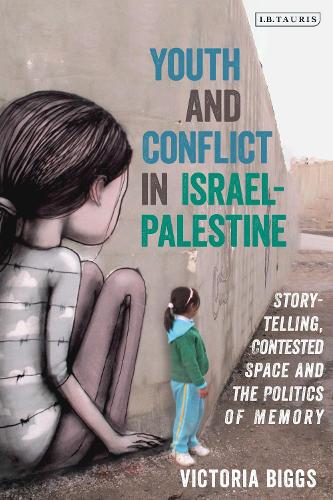
Investigates the attitudes and feelings of children and young people in Israel/Palestine through analysis of their storytelling
How are forbidden histories told and transmitted among young people in Israel/Palestine? What can their stories teach us about their everyday experiences of segregation and political violence?
This book investigates how young people use storytelling to navigate borders, memory, and unseen spaces, and to confront questions of belonging and those they see as the ‘other’. The study is unique in its inclusion of children from a broad spectrum of communities, including Palestinian refugee camps and right-wing Israeli settlement homes. The book shows that boundary spaces are fertile ground for the transmission of forbidden stories and memories.
Young people are at the centre of the research and Victoria Biggs argues that storytelling reveals much more about their experiences and perceptions than either quantitative data or qualitative interviews. Through analysis of the language, metaphor, violence, and endings employed in the stories, storytelling is shown to be a political act that plays a vital role in shaping conflict-affected young people’s concepts of community, exclusion, and belonging.
"[I]n addition to the book’s empirical contributions, it makes methodological and theoretical contributions by adding to the corpus of knowledge on storytelling, narration, and contested histories ... Further, Biggs raises ethical questions regarding carrying out research in overstudied areas and explains how she adjusted her own approach to better listen to and empower the youth with whom she worked; thus, this book is of relevance to students of fieldwork methods more broadly, not only to those working in Israel/Palestine." - Journal of Palestine Studies