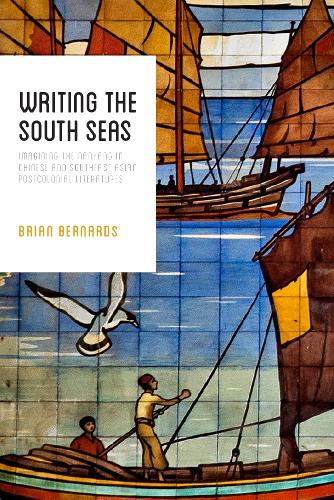
Книга Writing the South Seas: Imagining the Nanyang in Chinese and Southeast Asian Postcolonial Literature
Bernards has written an important and fascinating book on the trope of the Nanyang, or South Seas, in modern Chinese and Southeast Asian literatures. He challenges traditional notions of canon formation and national literatures, and offers an engaging account of the hybrid cultural forms produced through the intercultural encounters of the Nanyang. -- Emma Teng, author of Eurasian: Mixed Identities in the United States, China, and Hong Kong, 1842-1943 Writing the South Seas is a most fascinating inquiry into the institutionalization and dissemination of overseas modern Chinese-language literature in Southeast Asia from the early modern era to the present day. -- David Der-wei Wang, author of The Lyrical in Epic Time: Chinese Intellectuals and Artists Through the 1949 Crisis
Postcolonial literature about the South Seas, or Nanyang, examines the history of Chinese migration, localization, and interethnic exchange in Southeast Asia, where Sinophone settler cultures evolved independently by adapting to their "New World" and mingling with native cultures. Writing the South Seas explains why Nanyang encounters, neglected by most literary histories, should be considered crucial to the national literatures of China and Southeast Asia.
"
"Bernards’ book is a successful rewriting of the contours of South East Asian Sinophone literature and identity, which shines a deserving postcolonial light onto its emergent national cultures. . . . Highlighting a space that frequently challenges definition, it deserves attention from postcolonial, Southeast Asian and Chinese specialists alike."
" - Postcolonial Studies"
"What permeates this entire volume is a maritime vocabulary representing not only the physical passages of people across the seas but, more important, the consequent traversals occurring in the realm of culture, language, and literature as Chinese immigrants adapt to a new environment. The result is a rich tapestry of writings that embody the experiential gamut of Chinese immigrants physically uprooted from their place of ancestry but unfailingly re-visioning a world amidst the changes."
" - Southeast Asian Studies"
"Bernards’s meticulous conceptualization of ‘Nanyang’ as a novel theoretical idiom makes a salient contribution to the critical vocabulary of postcolonialism. Correcting the field’s geographical favouritism, Writing the South Seas provides a bracing account of the sinophone presence in Southeast Asia and prompts new reflections on the debatable positioning of China in postcolonial studies."
" - Journal of Postcolonial Writing"
"A must-read for literary scholars interested in broadening their horizons, Writing the South Seas will no doubt inspire much important future work in these directions."
" - Modern Chinese Literature and Culture"
"Brian Bernards’ enjoyable and illuminating book successfully diversifies the way we think about national literatures as well as about Sinophone literature as essentially a diaspora phenomenon. . . . This book will prove an eye-opening read, not only for scholars and enthusiasts of Sinophone and southeast Asian literatures, but for linguists and literary scholars everywhere."
" - New Books Asia"
"Bernards’s endeavor complicates the modern Chinese writing scene (the New Literature especially) in a refreshing manner...Bernards has produced a first-rate scholarly work that brings to life the entire writing scene in the Nanyang with knowledge that rivals a native informant’s."
" - Harvard Journal of Asiatic Studies"
"Bernards’ book is a successful rewriting of the contours of South East Asian Sinophone literature and identity, which shines a deserving postcolonial light onto its emergent national cultures. . . . Highlighting a space that frequently challenges definition, it deserves attention from postcolonial, Southeast Asian and Chinese specialists alike."
" - Postcolonial Studies