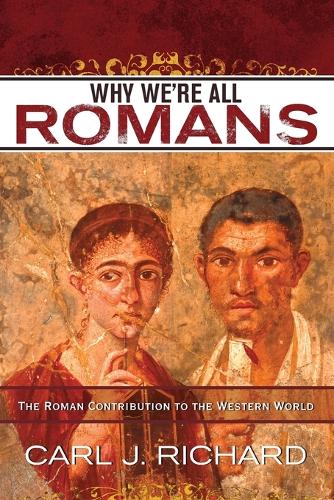
Книга Why We're All Romans: The Roman Contribution to the Western World
This engaging yet deeply informed work not only examines Roman history and the multitude of Roman achievements in rich and colorful detail but also delineates their crucial and lasting impact on Western civilization. Noted historian Carl J. Richard argues that although we Westerners are "all Greeks" in politics, science, philosophy, and literature and "all Hebrews" in morality and spirituality, it was the Romans who made us Greeks and Hebrews. As the author convincingly shows, from the Middle Ages on, most Westerners received Greek ideas from Roman sources. Similarly, when the Western world adopted the ethical monotheism of the Hebrews, it did so at the instigation of a Roman citizen named Paul, who took advantage of the peace, unity, stability, and roads of the empire to proselytize the previously pagan Gentiles, who quickly became a majority of the religion's adherents. Although the Roman government of the first century crucified Christ and persecuted Christians, Rome's fourth- and fifth-century leaders encouraged the spread of Christianity throughout the Western world. In addition to making original contributions to administration, law, engineering, and architecture, the Romans modified and often improved the ideas they assimilated. Without the Roman sense of social responsibility to temper the individualism of Hellenistic Greece, classical culture might have perished, and without the Roman masses to proselytize and the social and material conditions necessary to this evangelism, Christianity itself might not have survived.
"Richard (history, Univ. of Louisiana, Lafayette; Greeks & Romans Bearing Gifts: How the Ancients Inspired the Founding Fathers) gives us another work on classical influences, aimed at educated but nonexpert readers. Taking a broader focus than in his previous titles, he does not limit his study only to influences on early America but seeks to demonstrate how Roman culture influenced later Western culture in nearly all disciplines, including law, engineering, literature, and philosophy. Working on this monumental scale over such well-trod ground requires some deftness, and . . . Richard’s prose is clear and engaging (he cites excerpts from his previous Twelve Greeks and Romans Who Changed the World). . . . An entertaining and informative book for readers interested in a broad view of Western reception of Roman culture." - Library Journal
"Richard (Univ. of Louisiana at Lafayette) has written a readable, accessible overview of ancient Roman society and history. Organized thematically, the book examines a wide variety of topics, including Roman engineering, philosophy, and literature. Each chapter provides a succinct summary of Roman contributions in these fields, along with a description of how these contributions have affected later periods in Western history. Richard's overall argument is that the Romans deserve credit for helping to transmit both Greek and Jewish ideas into Western civilization, as well as for their own unique contributions, especially in the fields of architecture, engineering, and law. The book includes a one-chapter account of Roman political and military history, beginning with the founding of the city of Rome and stretching through the fall of the Roman Empire. . . . This book is a useful basic overview of Roman history. Summing Up: Recommended. General and undergraduate collections" - CHOICE
"Lively account of Ancient Rome." - Italian American Magazine
"The author makes his case in an engaging and entertaining way. . . . He writes with remarkable clarity. His description of the Latin language as 'vigorous and precise' could well apply to his own prose, and the text is enlivened by his wry humor. Richard has a particular knack for selecting anecdotes that are telling and often amusing. . . . His historical assessments . . . are consistently balanced and perceptive. . . . This book will serve as a very good introduction to the ancient Romans and their achievements, and readers with a prior knowledge of the topic will profit from the author’s insights." - Renaissance Magazine