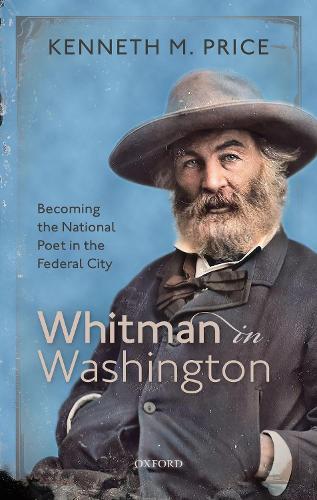
Книга Whitman in Washington: Becoming the National Poet in the Federal City
During Walt Whitman's decade in Washington, DC, 1863-1873, he labored intensely, at times seeming to have three lives at once. He wrote the most distinguished journalism of his career; came into his own as a writer of letters; crafted memorable Civil War poetry, Drum-Taps and Sequel to Drum-Taps and later folded it into heavily revised and expanded versions of Leaves of Grass; and produced his searching but also flawed critique of American culture, Democratic Vistas. Whitman's work through the first three editions of Leaves often receives the highest praise, yet his writing in the Washington years is exceptional, too, by any reckoning--and is all the more remarkable given that he also cared for thousands of wounded and sick soldiers in Washington hospitals, serving as an attentive visitor. In addition, he served as a government clerk in various positions, most notably in the attorney general's office when much was accomplished on the road toward a multi-racial democracy including efforts to suppress the Ku Klux Klan, and much was also missed (both by the attorney general's office and by Whitman) in the efforts to advance a more just and vibrant union. This book analyses Whitman's integrated life, writings, and government work in his urban context to re-evaluate the writer and the nation's capital in a time of transformation. Drawing on an expanded Whitman corpus, including nearly 3,000 Whitman documents the author recently identified in the National Archives, Whitman in Washington demonstrates that the power of Whitman's Civil War and Reconstruction writing emerges, more fully than we could ever before have imagined, from his intimate knowledge of the capital city, its bureaucracies, and its tumultuous post-war history.
"The virtue of Whitman in Washington is that it keeps tensions in place, and plumbs paradox, palpably wrestling with the legacy of Whitman in the moment and calling us to our own reckoning of him and his work for the future." - Tyler Hoffman, American Literary History
"Price works to untangle Whitman's complex, often contradictory, racial attitudes, showing through close readings and rich culture and aesthetic contextualization how his views of African Americans during slavery changed once emancipation occurred... The virtue of Whitman in Washington is that it keeps tensions in place, and plumbs paradox, palpably wrestling with the legacy of Whitman in the moment and calling us to our own reckoning with him and his work for the future." - Tyler Hoffman, American Literary History
"No other book has done so much to trace the contradictions inherent in the poet's work for the government and analyze the role it may have played in his poetry and politics." - Martin T. Buinicki, Valparaiso University
"Written with clarity and impressively researched, this study offers a remarkable picture of a key period in Whitman's life." - J. W. Miller, CHOICE