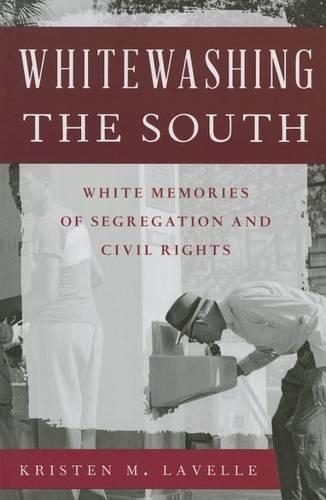
Книга Whitewashing the South: White Memories of Segregation and Civil Rights
Whitewashing the South is a powerful exploration of how ordinary white southerners recall living through extraordinary racial times—the Jim Crow era, civil rights movement, and the post-civil rights era—highlighting tensions between memory and reality. Author Kristen Lavelle draws on interviews with the oldest living generation of white southerners to uncover uncomfortable memories of our racial past. The vivid interview excerpts show how these lifelong southerners reflect on race in the segregated South, the civil rights era, and more recent decades. The book illustrates a number of complexities—how these white southerners both acknowledged and downplayed Jim Crow racial oppression, how they both appreciated desegregation and criticized the civil rights movement, and how they both favorably assessed racial progress while resenting reminders of its unflattering past. Chapters take readers on a real-world look inside The Help and an exploration of the way the Greensboro sit-ins and school desegregation have been remembered, and forgotten. Digging into difficult memories and emotions, Whitewashing the South challenges our understandings of the realities of racial inequality.
"“Time to shed the ‘progressive mystique’ and confront racism in Seattle,” Sharon H Chang, Mar 2, 2015, The Seattle Globalist: ------ When I started reading Whitewashing the South: White Memories of Segregation and Civil Rights, I really didn’t think it had much to do with Seattle. Sociologist Kristen M. Lavelle interviewed older white southerners who had lived through segregation and civil rights in Greensboro, North Carolina—often cited as the birthplace of the sit-in movement which launched the entire civil rights movement. But then I got to this: “During the segregation era, North Carolina had the reputation of being the most racially progressive southern state.” “The city of Greensboro,” Lavelle continues, “in particular had long prided itself for being a unique space of racial enlightenment…” Lavelle aptly refers to the city’s attempt at billing itself as racially advanced when it clearly was not, and cites its “progressive mystique.” And my eyes widened as my jaw dropped a million miles to the floor. Racially enlightened? Progressive mystique? That sounded awfully familiar. This is the same way Seattle loves to think of itself today. . . . ------ There is an important takeaway here: history tends to repeat itself and Seattle is at risk. We need to be very careful about using loaded language like “racially progressive” when the problem of racism is nowhere close to being solved here or anywhere else. Lavelle points out there are striking similarities between the elder white southerners she interviewed and colorblind views today that assume everyone has the same opportunities and rationalizes (or altogether refuses to see) persistent inequities. The point for us Seattleites is that the progressivism and colorblindness we ascribe to has been used before, and to very ill effect. Such beliefs lull us into complacency and even render us complicit. Racism is not a problem that “other” people need to deal with. It’s our problem too; something we all need to acknowledge, address and undo. Wake up Seattle and shake off your “progressive mystique.” We still have a lot of work to do." - The Seattle Globalist
"Attempting to clarify the persistence of black-white racism in the South by examining white attitudes, sociologist Lavelle uses a commonsense approach: she interviewed 44 Greensboro, NC, white elders (33 women, 11 men) to document their memories of growing up in the Jim Crow, civil rights, and post–civil rights eras. Lavelle records her interviewees’ stories, denials, justifications, and glosses while assessing their words within a sociological theoretical framework. This is ostensibly an academic and objective inquiry, but one wonders how objective the study can be when the author premises that the narrators' families comprised part of a white southern culture whose ingrained racism maintained 'race ... [as] the key boundary that structured the Jim Crow South....' Creating a book readers will either hate or love, with few finding a middle ground, Lavelle examines white perception and comprehension of black lives both in the private/domestic and public spheres, which illustrates her genuine effort to conduct viable research. Ultimately, any evaluation of the book must rest on the degree to which her 2007—2009 study provides an enriched understanding of the Jim Crow South through an accurate representation and subsequent analysis of typical white attitudes. Sure to launch discussion. Summing Up: Recommended. All levels/libraries." - CHOICE