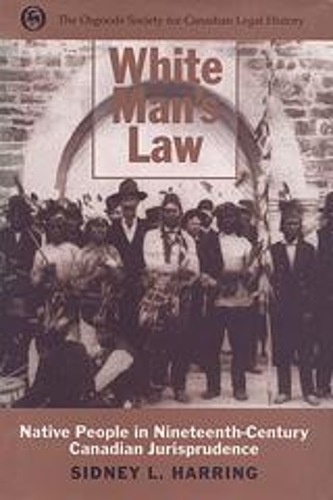
'Harring has given us a most penetrating and comprehensive account of the treatment of Indians in nineteenth-century Canadian courts. He illuminates brilliantly how the judges' application of the rule of law, an essential element in the 'liberal treatment' of Indians, can serve as a blunt instrument for the dispossession and subjugation of Aboriginal peoples' -- Peter H. Russell, Professor Emeritus, Faculty of Political Science, University of Toronto
In the nineteenth century many Canadians took pride in their country's policy of liberal treatment of Indians. In this thorough reinvestigation of Canadian legal history, Sidney L. Harring sets the record straight, showing how Canada has consistently denied Aboriginal peoples even the most basic civil rights.
Drawing on scores of nineteenth-century legal cases, Harring reveals that colonial and early Canadian judges were largely ignorant of British policy concerning Indians and their lands. He also provides an account of the remarkable tenacity of First Nations in continuing their own legal traditions despite obstruction by the settler society that came to dominate them.
The recognition of 'pre-existing Aboriginal rights' in the Constitutional Act of 1982 has shown that Aboriginal legal traditions have a definite place in contemporary Canadian law. This study clearly demonstrates that Canadian Native legal culture requires further study by scholars and more serious attention by courts in rendering decisions.