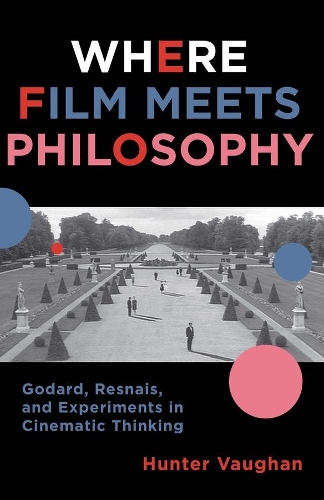
Книга Where Film Meets Philosophy: Godard, Resnais, and Experiments in Cinematic Thinking
Vaughan's discussions of the films of Resnais and Godard are incisive and engaging, providing welcome relief from the difficulties of abstruse philosophical debates, offering clarification of the practical implications of their theoretical points, and enriching abstract concepts via a penetrating treatment of the specific techniques of film form as, in themselves, modes of thought with far-reaching conceptual implications. -- Ronald Bogue, author of Deleuzian Fabulation and the Scars of History A superb new contribution to film-philosophy. With wonderful insight, rigor, creativity, and verve, Vaughan draws on Merleau-Ponty and Deleuze to critically examine how film form can be aligned with thinking and to question what this might mean for our engagement with the world. This standout book makes an important intervention into both recent discussions in film studies and longer running philosophical debates. -- David Martin-Jones, author of Deleuze and World Cinemas
Hunter Vaughan interweaves phenomenology and semiotics to analyze cinema's ability to challenge conventional modes of thought. Merging Maurice Merleau-Ponty's phenomenology of perception with Gilles Deleuze's image-philosophy, Vaughan applies a rich theoretical framework to a comparative analysis of Jean-Luc Godard's films, which critique the audio-visual illusion of empirical observation (objectivity), and the cinema of Alain Resnais, in which the sound-image generates innovative portrayals of individual experience (subjectivity). Both filmmakers radically upend conventional film practices and challenge philosophical traditions to alter our understanding of the self, the world, and the relationship between the two. Films discussed in detail include Godard's Vivre sa vie (1962), Contempt (1963), and 2 or 3 Things I Know About Her (1967); and Resnais's Hiroshima, mon amour (1959), Last Year at Marienbad (1961), and The War Is Over (1966). Situating the formative works of these filmmakers within a broader philosophical context, Vaughan pioneers a phenomenological film semiotics linking two disparate methodologies to the mirrored achievements of two seemingly irreconcilable artists.