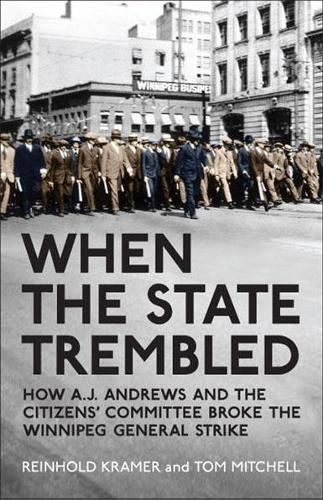
Книга When the State Trembled: How A.J. Andrews and the Citizens' Committee Broke the Winnipeg General Strike
'When the State Trembled is truly a landmark study in Canadian working-class history, but it is even more than that-it is a deeply revealing analysis of the inner workings of a Canadian social and political order responding to its acute post-1918 crisis. With profound scholarship, broad-ranging theorizing, an unrivalled command of the primary sources, and sharp eyes for the telling detail and the illuminating story, Reinhold Kramer and Tom Mitchell present a completely new interpretation of the Winnipeg General Strike. They show how one brilliant reactionary could call upon long-standing traditions of the "private" and the "public," the "citizen" and the "alien," the "propertied" and the "disordered" to craft a deadly and effective response to Canada's post-1918 democratic revolution. This new interpretation of Winnipeg 1919 will be debated across the country-and the result will be not just a new understanding of the famous Strike but of Canada as a liberal order.' -- Ian McKay, Department of History, Queen's University 'When the State Trembled is a masterful, riveting, and fresh account of the Winnipeg General Strike that emphasizes the role of Winnipeg's legal and business elite who not only mobilized the state but also assumed its mantle to defeat the strike and punish its leaders. At a time when perceived threats to national security are being used to justify restrictions on our civil liberties, this book could not be timelier.' -- Eric Tucker, Osgoode Hall Law School, York University
The Winnipeg General Strike of 1919, which involved approximately 30,000 workers, is Canada's best-known strike. When the State Trembled recovers the hitherto untold story of the Citizens' Committee of 1000, formed by Winnipeg's business elite in order to crush the revolt and sustain the status quo. This account, by the authors of the award-winning Walk Towards the Gallows, reveals that the Citizens drew upon and extended a wide repertoire of anti-labour tactics to undermine working-class unity, battle for the hearts and minds of the middle class, and stigmatize the general strike as a criminal action. Newly discovered correspondence between leading Citizen lawyer A.J. Andrews and Acting Minister of Justice Arthur Meighen illuminates the strategizing and cooperation that took place between the state and the Citizens. While the strike's break was a crushing defeat for the labour movement, the later prosecution of its leaders on charges of sedition reveals abiding fears of radicalism and continuing struggles between capital and labour on the terrain of politics and law.