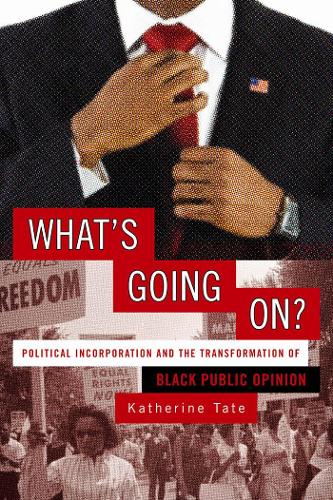
Книга What's Going On?: Political Incorporation and the Transformation of Black Public Opinion
Katherine Tate's new empirical work on African American public opinion moves the field into a wholly new direction. Instead of analyzing the diverse ideologies within this public opinion, this bold and novel pioneering work assesses and evaluates the dynamism in this opinion between 1970 to 2004 with insights from 2008. Tate makes a startling argument and finding: African American public opinion has moved from its left/liberal mooring to now a moderate/centrist position but is currently poised so as to be shifted back given the outcome of the Obama Administration. Her thesis is that African American political incorporation has moderated the radical nature of African American public opinion. This book is a fascinating read. It is also a brilliant and original work. -- Hanes Walton Jr., The University of Michigan What's Going On? is a provocative and informative examination of African American public opinion. Scholars of Black politics will consult and debate this important work for many years to come. -- Vincent Hutchings, Institute for Social Research, The University of Michigan
In political opinion surveys from the 1950s through the 1970s, African Americans were consistently among the most liberal groups in the United States and were much further to the left than White Americans on most issues. Starting in the 1980s, Black public opinion began to move to the center, and this trend has deepened since. Why is this the case? Katherine Tate contends that Black political incorporation and increased affluence since the civil rights movement have made Black politics and public opinion more moderate over time. Black leaders now have greater opportunity to participate in mainstream politics, and Blacks look to elected officials rather than activists for political leadership. Black socioeconomic concerns have moved to the center as poverty has declined and their economic opportunities have improved. Based on solid analysis of public opinion data from the 1970s to the present, Tate examines how Black opinions on welfare, affirmative action, crime control, school vouchers, civil rights for other minorities, immigration, the environment, and U.S. foreign policy have changed.